EC Fan Array Retrofits NYC | Hospitals & Commercial Buildings
EC Fan Array Retrofits in NYC Hospitals and Commercial Buildings
Updated for 2026: This guide includes newer GRR field examples, hospital retrofit lessons, NYC access constraints, Local Law 97 context, and practical checks for evaluating EC fan array retrofits.
EC fan array retrofits help older hospitals, laboratories, and commercial buildings modernize airflow systems without always replacing the full air handling unit.
Instead of relying on one large belt-driven fan, an EC fan array uses multiple direct-drive fan modules working together inside the existing AHU or fan section. This can improve redundancy, control, serviceability, and energy performance when the system is properly engineered.
For New York City buildings, the decision is rarely only about the fan. It is about access, shutdown windows, controls, commissioning, Local Law 97 pressure, and whether the building can keep operating while the work is completed.
Short Answer
An EC fan array retrofit replaces an older fan section with multiple compact EC fan modules inside the existing AHU or mechanical space.
In NYC hospitals and commercial buildings, this approach can reduce belt maintenance, improve airflow control, add redundancy, and support energy reduction goals without requiring a full AHU replacement.
The best result depends on field survey, airflow calculation, static pressure review, access planning, controls integration, balancing, and commissioning after HVAC Retrofit.

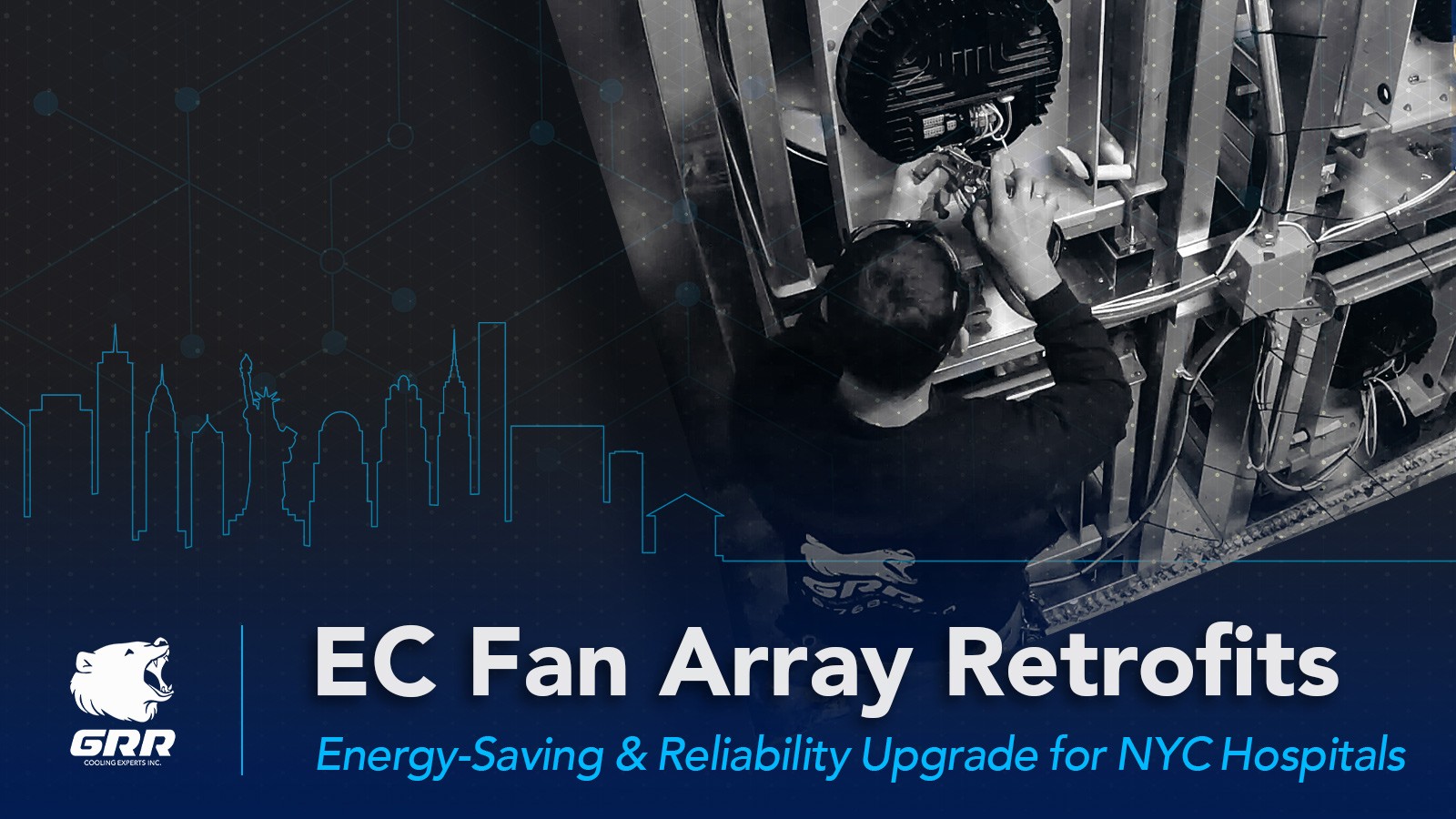
GRR Cooling Experts technicians installing a modular EC fan array inside an existing AHU during a NYC hospital HVAC retrofit.
Why EC Fan Arrays Matter in NYC Retrofits
Many New York buildings operate with older HVAC systems, limited mechanical room access, and short shutdown windows.
A traditional fan replacement may require cranes, major demolition, custom parts, or a long outage plan. EC fan arrays can often be brought in as smaller modules, assembled inside the existing AHU footprint, and commissioned around the building’s operating schedule.
This matters in:
hospitals
operating rooms
laboratories
pharmaceutical spaces
commercial towers
older mechanical rooms
occupied buildings with limited shutdown windows
Local Law 97 also changes how many NYC owners look at HVAC upgrades. The law requires many large buildings to meet greenhouse gas emissions limits, which makes fan energy, system efficiency, and retrofit planning more important for long-term building performance.
Related resource: Local Law 97 and HVAC Retrofit in NYC
NYC reference: Local Law 97, NYC Buildings
Fan Array vs Fan Wall Terminology
EC fan array is the broader engineering term used here for a group of direct-drive fan modules operating together inside an AHU or fan section. Fan wall is also commonly used for wall-like multi-fan configurations and is often used interchangeably in retrofit discussions. Some manufacturers use additional product terminology, including Fan Grid.

For retrofit planning, the label is secondary to required airflow, static pressure, controls, redundancy, access, and serviceability. For broader retrofit terminology and planning context, see GRR’s HVAC Retrofit NYC engineering guide.
What an EC Fan Array Changes
An EC fan array replaces one large fan with several smaller fans operating in parallel.
This changes the retrofit logic in several ways:
smaller components can be easier to move through tight access paths
direct-drive fans remove belt maintenance
variable-speed control improves airflow adjustment
multiple fan modules can support redundancy
controls can provide better operating visibility
service can be simpler after handover
EC fan technology is used in HVAC because it can support efficient variable-speed operation, airflow control, and lower operating cost compared with many older fan arrangements.
Technical reference: ZIEHL-ABEGG ECblue high-efficiency motors
Where EC Fan Arrays Are Strongest
EC fan arrays are usually strongest when the building has one or more of these conditions:
old belt-driven fans
repeated motor, bearing, belt, or shaft issues
limited access to the fan section
no practical crane or roof access
high maintenance burden
need for better airflow control
need for redundancy
Local Law 97 energy pressure
hospital or lab spaces where airflow interruption is risky
This is why EC fan arrays are often evaluated in NYC retrofit work where the building itself shapes the solution.
Related resource: Why Tight Access Turns a Simple Fan Replacement Into an HVAC Retrofit
Why Hospitals Evaluate EC Fan Arrays Differently
Hospitals do not evaluate HVAC retrofits like ordinary commercial buildings.
A hospital retrofit may involve:
operating room ventilation
pressure relationships
infection control sensitivity
occupied patient areas
night or weekend work
temporary operating conditions
restart planning
balancing and commissioning before handoff
For these environments, the value of an EC fan array is not only energy savings. It is stable airflow, redundancy, serviceability, and a more controlled path back to operation.
Related resource: EC Fan Array Redundancy for Hospital HVAC Retrofits in NYC
Reliability and Redundancy in EC Fan Arrays
EC fan arrays can support system uptime by using multiple fan modules instead of relying on one large fan. In an N+1 configuration, the array includes one additional fan beyond the required operating capacity. If one fan module stops, the remaining fans can continue operating and help maintain airflow until service is completed.
This is especially important in hospitals, operating rooms, laboratories, and other critical environments where airflow interruption can create operational risk.
A well-designed EC fan array can also improve serviceability because individual fan modules are easier to access and replace than one large belt-driven fan assembly.

A schematic representation of N+1 EC fan array redundancy. If one fan module stops, the remaining modules can continue supporting airflow. Image by GRR Cooling Experts.
See additional answers in our HVAC Retrofit FAQs.
Why Commercial Buildings Use EC Fan Arrays
Commercial buildings often look at EC fan arrays for a different reason.
The issue may be
an older AHU, a failed fan, limited access, tenant comfort complaints, rising energy cost, or pressure to improve building performance.
In older NYC commercial buildings, the fan may be buried in a penthouse, basement, interior mechanical room, or tight ceiling space. A modular fan array can reduce the need for major structural access compared with replacing one large fan assembly.
Related resource: HVAC Retrofit in New York Without Downtime
GRR Field Examples
GRR Cooling Experts works on HVAC retrofit projects in live hospitals, healthcare facilities, and older New York buildings where access, shutdown windows, airflow stability, and restart planning matter.
BronxCare Hospital Return Fan Retrofit
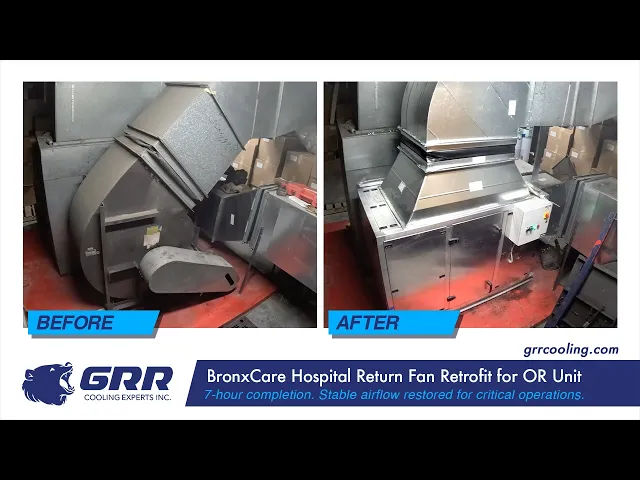
GRR completed a live hospital return fan retrofit at BronxCare in a 7-hour execution window. The project involved replacing an older return fan system, coordinating controls readiness, and completing the work inside a live healthcare environment.
The field footage below shows the type of existing-equipment conditions that make hospital HVAC retrofits different from standard equipment replacement: limited access, active building constraints, staging, controls readiness, and restart planning.
Field footage from a GRR Cooling Experts HVAC retrofit showing modular EC fan array installation work inside an existing air handling unit.
Related case: BronxCare Hospital Return Fan Retrofit in NYC
The examples below show how this retrofit logic applies across hospital, emergency response, and tight-access HVAC projects in New York City.
Emergency Hospital HVAC Response
In one emergency hospital HVAC response example, GRR documented a Montefiore Radiology Center supply fan modernization using three direct-drive EC motor fans designed around 15,000 CFM at 3.00 in. S.P. and matched to existing power conditions.
The same emergency response page also documents a 48-hour OR ventilation replacement with approximately 29,900 CFM restored.
Related resource: Emergency Hospital HVAC Response NYC
Tight-Access Retrofit Planning
GRR’s tight-access retrofit article documents why older NYC mechanical rooms can turn a simple fan replacement into a full retrofit planning problem.
The MEETH Hospital example involved a failed ceiling-mounted exhaust unit in a constrained location, rated for 6,000 CFM at 2 in.wg. static pressure, with duct adaptation and final sealing required to restore stable exhaust performance.
Related resource: Tight-Access HVAC Retrofit Planning
What GRR Checks Before Recommending an EC Fan Array
GRR does not treat EC fan arrays as a generic kit.
Before recommending a retrofit, the team reviews:
existing airflow requirements
static pressure
AHU dimensions
access path
duct connection points
electrical service
controls and BAS integration
shutdown window
balancing requirements
commissioning plan
service access after installation
The goal is not just to install new fans. The goal is to restart the system with verified airflow and a practical maintenance path.
Related service page: HVAC Retrofit Engineering Services in NYC
GRR FIELD GUIDE
Download GRR Field Problem Notes, Volume 1
Equipment selection is only one layer of an EC fan array retrofit. Volume 1 shows how access constraints, shutdown sequencing, controls, commissioning, and verified restart shape the actual field execution path.
View / Download the Field Guide
Explore all GRR HVAC retrofit guides
EC Fan Array vs. Traditional Fan Replacement
A traditional fan replacement may be the right choice when access is simple, downtime is available, and the existing system design still works.
An EC fan array is usually stronger when the building needs:
modular installation
better redundancy
better controllability
reduced belt maintenance
improved service access
shorter shutdown planning
better long-term operating visibility
The right answer depends on the building, not the brochure.
Related resource: EC vs AC Fan Retrofit Choice in NYC
Common EC Fan Array Retrofit Mistakes
Sizing from old nameplate data only
Old equipment data may not reflect actual system behavior. Airflow and static pressure should be verified against current building conditions.
Ignoring access constraints
A solution that works on paper may fail in the field if the team does not check doors, corridors, ceiling space, rigging path, and staging limits.
Treating controls as an afterthought
EC fan arrays need proper staging, safeties, alarms, setpoints, and BAS integration. Controls planning should happen before installation, not after.
Skipping balancing and commissioning
A fan array must be tested and balanced after installation. Without proper commissioning, the system may not deliver the expected result.
Assuming every AHU is a good candidate
Not every air handling unit should receive the same solution. Cabinet condition, coil condition, electrical service, control readiness, access, and operating risk all matter.
Related resource: 3 HVAC Retrofit Mistakes That Break Projects in NYC Buildings
When EC Fan Arrays May Not Be the Right Choice
EC fan arrays are useful in many retrofit conditions, but they are not automatically the right answer for every AHU.
They may not be the best first move if:
the AHU casing is failing
coils or drain pans need major replacement
electrical capacity is not suitable
controls cannot support proper staging
access is too limited for safe installation
airflow problems are caused by duct or coil restrictions instead of the fan section
the building needs a larger system redesign, not a fan-only retrofit
This is why GRR reviews the full system before recommending a retrofit path.
Before choosing a fan-only upgrade, facility teams should decide whether the existing AHU needs repair, targeted retrofit, or full replacement.
Related GRR Retrofit Resources
Use these GRR resources to compare EC fan array retrofit planning with related hospital, emergency, tight-access, and downtime-focused HVAC retrofit work
HVAC retrofit engineering services in NYC
Review GRR’s core retrofit, AHU upgrade, fan array, balancing, and service capabilities.GRR hospital retrofit case studies
See completed HVAC retrofit projects in hospitals, healthcare facilities, and large commercial buildings.BronxCare Hospital return fan retrofit in NYC
A live hospital return fan retrofit completed in a short execution window.Emergency hospital HVAC response in NYC
How GRR approaches urgent HVAC failures in healthcare and critical facility environments.Tight-access HVAC retrofit planning
Why older NYC mechanical rooms often turn simple fan replacement into retrofit planning work.HVAC retrofit in New York without downtime
How phased work, access planning, and commissioning help reduce disruption in occupied buildings.EC fan array redundancy for hospital HVAC retrofits
A focused guide on N+1 redundancy and airflow continuity in critical environments.EC vs AC fan retrofit choice in NYC
A practical comparison for teams evaluating fan technology during AHU retrofit planning.
FAQ
Q: Are EC fan arrays suitable for older NYC buildings?
Yes, when the system is properly surveyed and engineered. Older NYC buildings often have tight access, aging AHUs, and limited shutdown windows. EC fan arrays are modular, which can make installation more practical than replacing one large fan assembly.
Q: Do EC fan arrays help with Local Law 97?
They can support Local Law 97 planning by reducing fan energy use and improving control, but the actual impact depends on building run hours, fan load, controls, utility data, and total building emissions profile.
Q: Are EC fan arrays only for hospitals?
No. Hospitals are a strong use case because airflow reliability matters so much, but EC fan arrays can also work in laboratories, commercial buildings, schools, pharmaceutical facilities, and large occupied facilities.
Q: How long does an EC fan array retrofit take?
The timeline depends on access, system size, electrical work, controls, and commissioning. Many projects can be planned around weekend or short shutdown windows, but the right timeline should be based on a site walk and engineering review.
Q: What happens if one fan fails?
In a properly designed N+1 or N+2 configuration, the remaining fans can continue operating while the failed module is addressed. This is one reason EC fan arrays are useful in critical environments.
Q: Do controls need to be updated?
Usually yes. EC fan arrays need correct staging, safeties, alarms, setpoints, and BAS integration. Controls planning should happen before installation, not after.
Q: When is an EC fan array not the right choice?
It may not be the right choice if the existing unit has deeper coil, casing, duct, electrical, or access problems that make a fan-only retrofit insufficient. GRR evaluates the full system before recommending the retrofit path.
Q: Planning an EC Fan Array Retrofit in New York City?
GRR Cooling Experts can review your AHU, fan section, access path, controls, and shutdown window before you commit to a retrofit strategy.
Request an engineering site assessment to discuss your building, timeline, and airflow requirements.