Verified Airflow After HVAC Retrofit: Balancing, Controls & Commissioning in NYC Buildings
What needs to be verified after an HVAC retrofit?
After an HVAC retrofit, the system should be checked for airflow, controls response, fan speed, alarms, restart behavior, and stable operation under real building conditions. This is especially important in hospitals, laboratories, critical environments, and older NYC buildings where access, downtime, and airflow reliability matter.
For related capabilities, see GRR’s HVAC retrofit services in NYC.
Why installation is not the finish line
Many HVAC retrofit projects focus on the visible part of the work: removing old equipment, installing new fans, replacing components, adapting ductwork, or upgrading an AHU section.
That work matters. But it is only part of the outcome.
A retrofit is successful only when the system can deliver the required airflow, respond properly to controls, restart predictably, and support the building’s operating needs.
This is especially important in existing NYC buildings, where mechanical rooms are tight, ductwork is old, access is limited, and shutdown windows are short. GRR has covered this challenge in more detail in its guide to tight-access fan replacement.
In these conditions, even a well-installed upgrade can create problems if the system is not properly balanced and commissioned after the work is complete.
For facility teams, the real question is not only:
Was the equipment replaced?
The better question is:
Is the system now performing correctly?
What can go wrong after an HVAC retrofit
After a fan replacement, AHU upgrade, coil replacement, or fan array retrofit, several issues can appear if final verification is rushed or skipped.
Common problems include:
Airflow is too low or too high
Fan speed is not properly adjusted
Controls do not respond as expected
Alarms or status signals are not properly coordinated
One area receives too much air while another receives too little
Static pressure changes after the retrofit
The system sounds different after restart
The BMS does not reflect real operating conditions
The new equipment works, but the full system is not stable
In critical environments, these problems are not small details. They can affect comfort, reliability, energy use, pressure relationships, operating schedules, and facility confidence.
That is why balancing, commissioning, and controls integration should be treated as part of the retrofit, not as an afterthought.
Why balancing matters after fan array upgrades
Fan array retrofits and EC fan upgrades can improve redundancy, controllability, and serviceability. But the system still needs to be balanced after installation.
For a broader planning view, see GRR’s guide to EC fan array retrofits in NYC hospitals and commercial buildings.
A new fan array does not operate in isolation. It works inside an existing air system with existing ductwork, filters, coils, dampers, controls, and building conditions.
Balancing helps confirm that the upgraded system is delivering the right airflow to the right places.
For existing buildings, this matters because the original system may have changed over time. Filters may be different. Ductwork may have been modified. Dampers may not be in the original position. Old equipment may have been operating outside its intended range for years.
After a retrofit, balancing helps bring the system back to a controlled condition.
In practical terms, balancing can help confirm:
Airflow volume
Fan speed
Static pressure
Distribution across zones
System response after restart
Whether the retrofit matches the intended performance
For facility managers and building engineers, this is the difference between “new equipment installed” and “system performance verified.”
Controls integration: BMS, 0–10 V, speed control, and alarms
Modern retrofit work often involves more than mechanical replacement. Controls integration is a major part of final performance.
For EC fan arrays, fan walls, and upgraded AHU sections, the controls layer may include:
Speed control
0–10 V signal coordination
BMS integration
Alarm feedback
Fan status
Pressure response
Start / stop logic
Coordination with existing panels or control sequences
If the controls are not coordinated correctly, the equipment may be physically installed but not fully useful to the facility team.
A properly integrated system should allow building staff to understand how the upgraded equipment is operating. It should support better visibility, easier adjustment, and more predictable response.
For many NYC buildings, better control also matters when facility teams evaluate HVAC retrofit decisions under Local Law 97.
This is especially important in critical buildings, where facility teams need confidence after the system restarts.
Commissioning and verified restart
Commissioning is the step that confirms the retrofit is ready to operate as intended.
In a retrofit setting, commissioning may include:
Checking fan operation
Verifying control response
Confirming speed ranges
Reviewing airflow conditions
Checking alarms or status signals
Observing restart behavior
Confirming that the system is stable after the work is complete
The goal is simple:
The system should not only turn on. It should run correctly.
In live buildings, this step is even more important because the work often happens under pressure. Shutdown windows may be limited. The building may need to return to service quickly. Facility teams may need confirmation that the system is stable before normal operations resume.
A verified restart gives the team more confidence that the retrofit was completed properly.
Why this matters in hospitals, labs, and critical environments
Hospitals, laboratories, pharmaceutical spaces, and other critical environments depend on stable air systems.
In these buildings, HVAC performance is connected to more than comfort. Airflow may support pressure relationships, filtration, humidity control, temperature stability, and operational continuity.
When a critical fan or AHU is upgraded, the building team needs to know that the system can perform after the retrofit. For systems where one fan failure can create operational risk, GRR also explains the role of EC fan array redundancy for hospital HVAC retrofits.
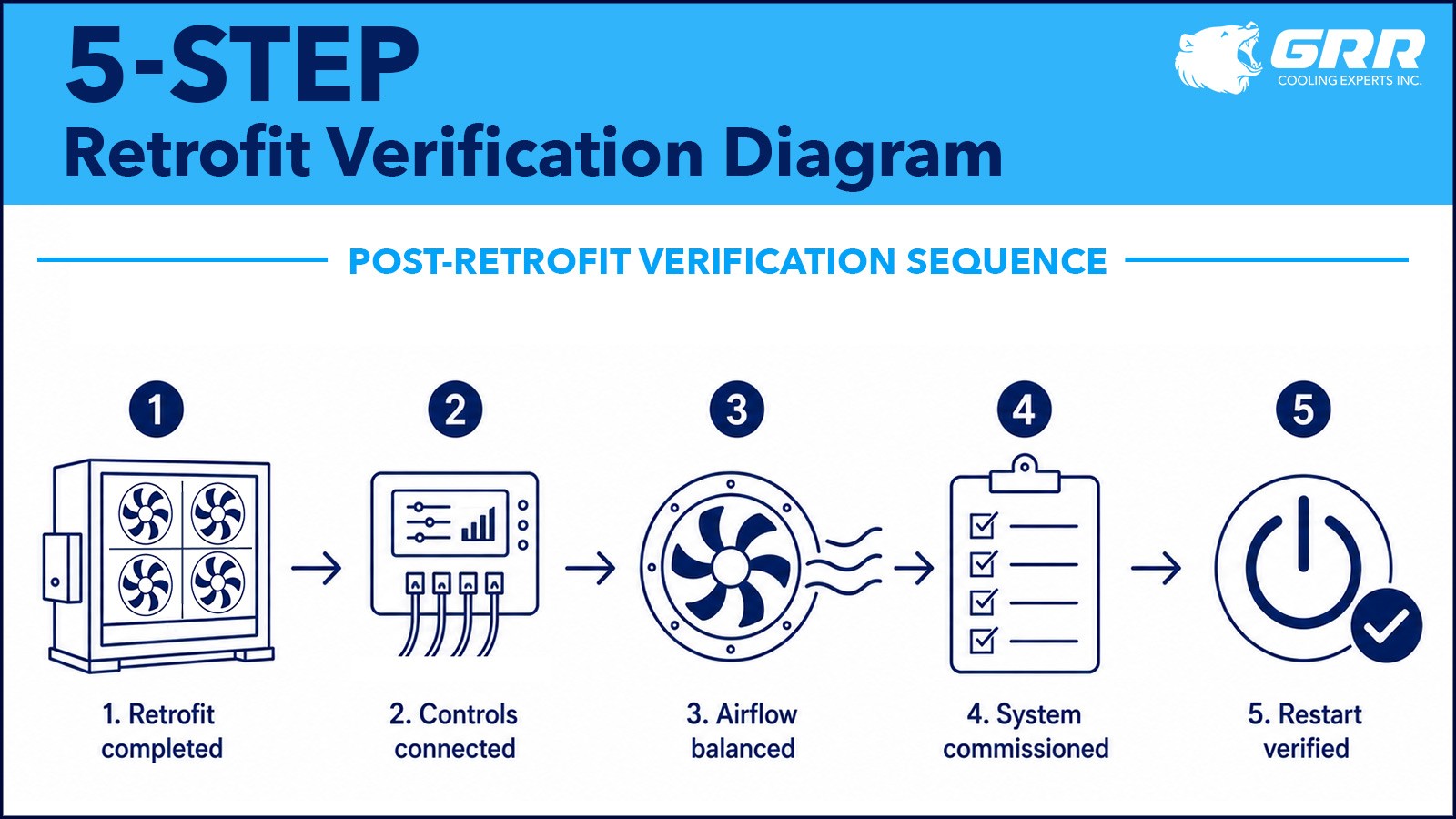
This is why the final steps matter:
Balancing confirms airflow
Controls integration confirms response
Commissioning confirms operation
Verified restart confirms readiness
For critical environments, these are not paperwork items. They are risk-reduction steps.
GRR FIELD GUIDE
Download GRR Field Problem Notes, Volume 1
A verified restart is only one part of a successful HVAC retrofit. Volume 1 connects post-retrofit verification with the access and shutdown constraints that must be resolved before field work begins.
View / Download the Field Guide
Explore all GRR HVAC retrofit guides
In urgent healthcare situations, verified performance also helps teams decide whether a repair is enough or whether a rapid retrofit is the safer path. GRR covers that decision path in its article on urgent healthcare HVAC response in NYC.
GRR’s field approach
GRR Cooling Experts focuses on HVAC retrofit work in real existing buildings across NYC and the Metro Area.
Many of these projects involve older mechanical rooms, limited access, short shutdown windows, live facility conditions, and critical operating requirements.
In this type of work, field judgment matters.
A strong retrofit approach should consider:
How the existing system was operating before replacement
What airflow is required after the upgrade
How the new fan system will respond to controls
What the facility team needs to see after restart
Whether the system is stable under real operating conditions
How future service access will be handled
GRR’s role is not only to install new equipment. The goal is to help restore, verify, and stabilize HVAC performance in buildings where downtime, access, and airflow reliability matter.
That decision starts before installation, with a clear review of whether the existing AHU should be repaired, retrofitted, or replaced.
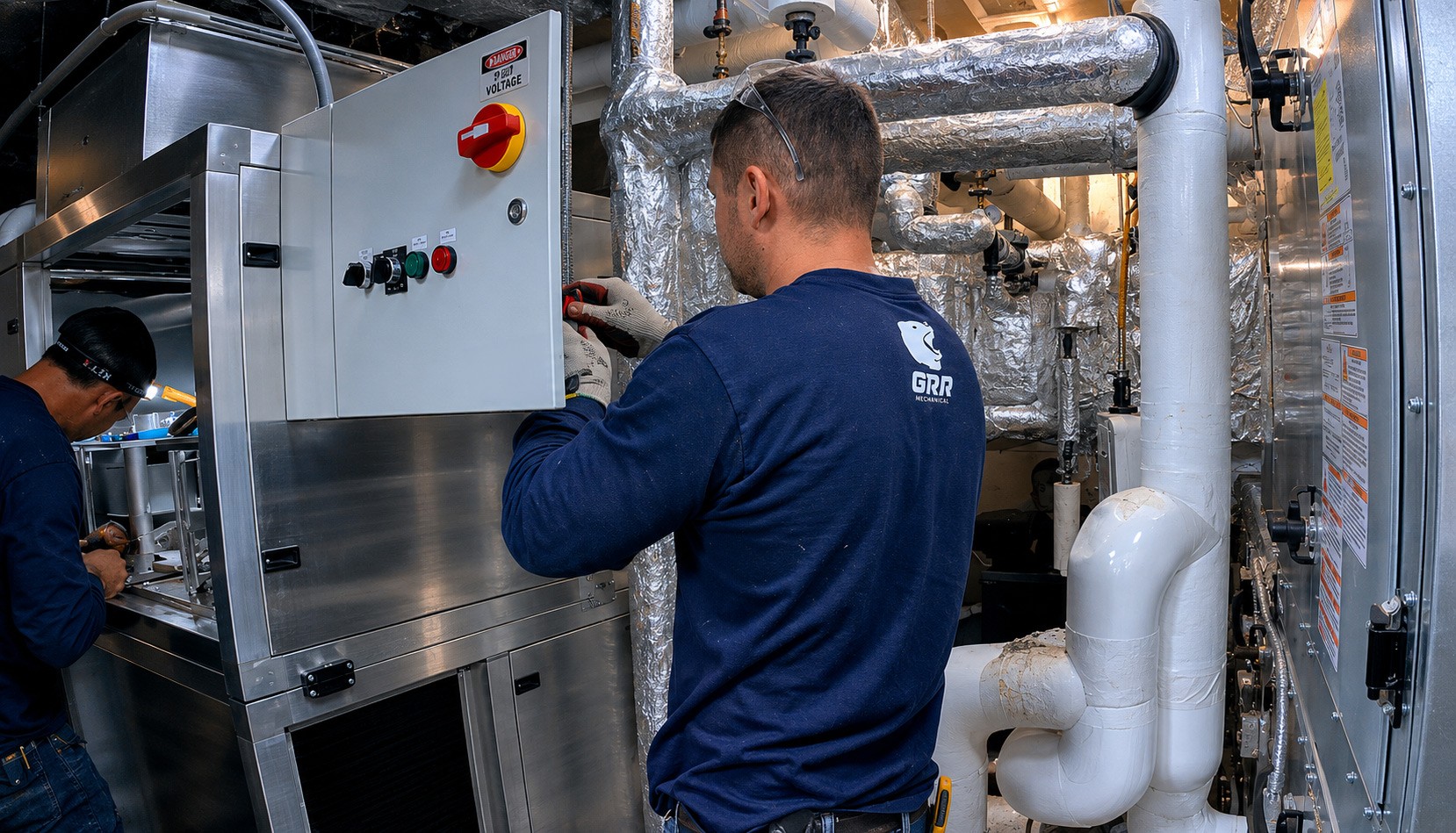
For completed field examples, see GRR’s HVAC retrofit case studies in hospitals, healthcare facilities, and large commercial buildings.
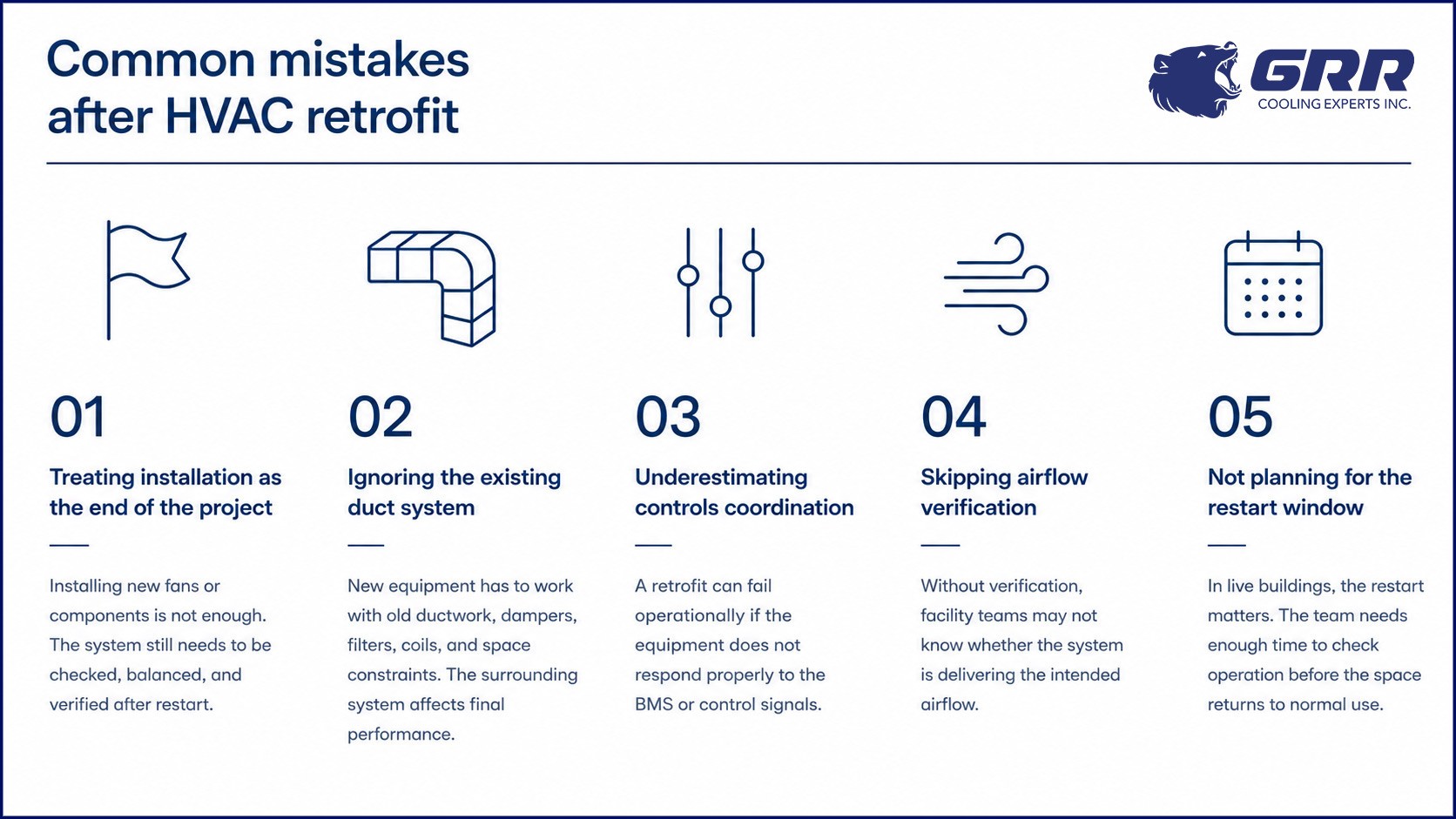
Common mistakes after HVAC retrofit
Treating installation as the end of the project
Installing new fans or components is not enough. The system still needs to be checked, balanced, and verified after restart.
Ignoring the existing duct system
New equipment has to work with old ductwork, dampers, filters, coils, and space constraints. The surrounding system affects final performance.
Underestimating controls coordination
A retrofit can fail operationally if the equipment does not respond properly to the BMS or control signals.
Skipping airflow verification
Without verification, facility teams may not know whether the system is delivering the intended airflow.
Not planning for the restart window
In live buildings, the restart matters. The team needs enough time to check operation before the space returns to normal use.
FAQ
Q: What is HVAC commissioning after a retrofit?
HVAC commissioning after a retrofit is the process of checking that the upgraded system operates as intended. It may include fan operation, airflow, controls response, alarms, speed settings, and restart behavior.
Q: Why is balancing important after fan replacement?
Balancing confirms that the system is delivering the right airflow after equipment has been replaced or upgraded. Without balancing, the new equipment may run, but the building may not receive the airflow it needs.
Q: Does an EC fan array still need commissioning?
Yes. EC fan arrays offer better controllability and redundancy, but they still need to be coordinated with the existing system, controls, and airflow requirements.
Q: What does controls integration mean in an HVAC retrofit?
Controls integration means connecting the upgraded equipment to the building’s control system or control signals so fan speed, status, alarms, and operation can be monitored or adjusted properly.
Q: Why does this matter in hospitals and critical environments?
Critical environments depend on stable airflow and predictable HVAC operation. After a retrofit, the facility team needs confidence that the system is not only installed, but verified and ready to operate.
Q: When should balancing and commissioning be planned?
They should be planned before the retrofit begins. This helps avoid rushed restart conditions and makes final verification part of the project, not a last-minute step.
A successful HVAC retrofit is not only about replacing old equipment. It is about restoring system performance. For NYC buildings, especially hospitals, labs, and critical environments, strong retrofit work includes installation, controls integration, balancing, commissioning, and verified restart.
That is how facility teams move from equipment replacement to operational confidence.
Request a retrofit assessment
Need to evaluate an existing HVAC system or plan a retrofit with verified airflow performance?
GRR Cooling Experts supports HVAC retrofit engineering, fan system upgrades, balancing, controls coordination, and commissioning for critical buildings across NYC and the Metro Area.
Request a site review or retrofit assessment through GRR’s engineering team.