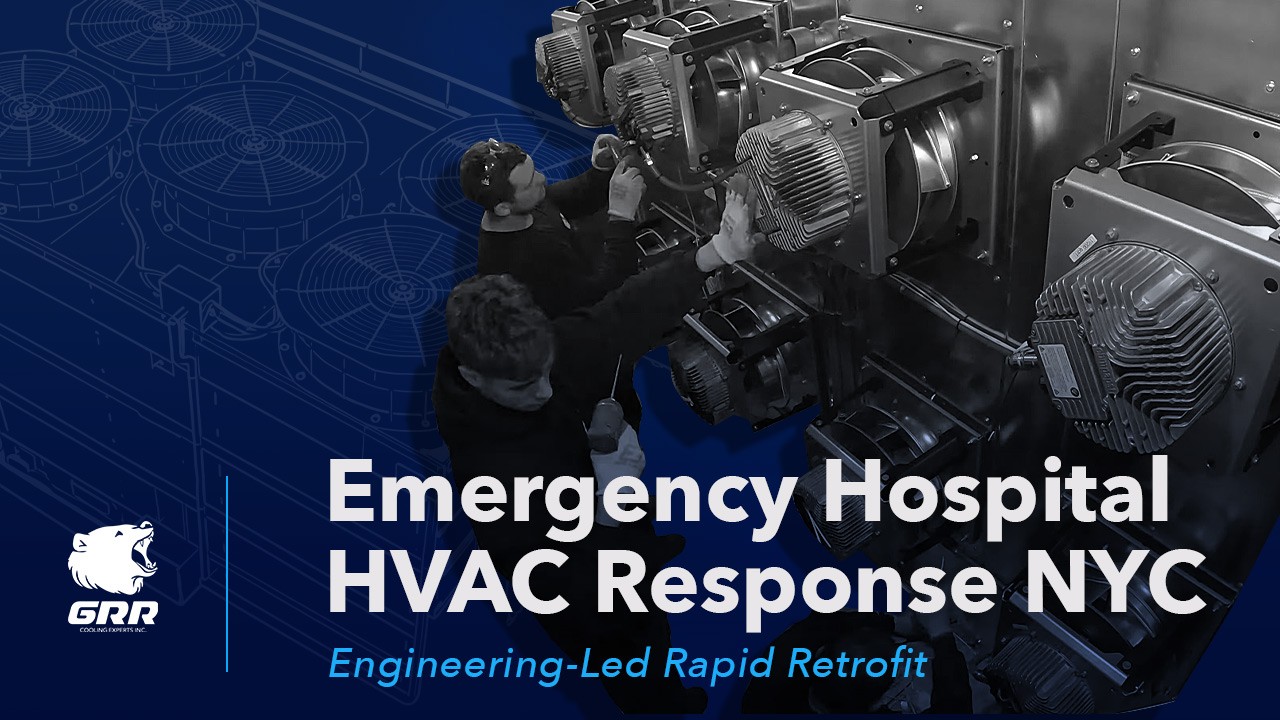
Emergency Hospital HVAC Response NYC by GRR
Engineering-led emergency response plus rapid retrofit when repair is not enough
What we do in a hospital HVAC emergency: We stabilize airflow and critical ventilation first, diagnose the failure mode fast, then execute either a verified repair or an engineered rapid retrofit when repair is not enough. We work in live hospital conditions and prioritize continuity in critical zones.
Serving NYC: Manhattan, Bronx, Brooklyn, Queens, Staten Island.
—-
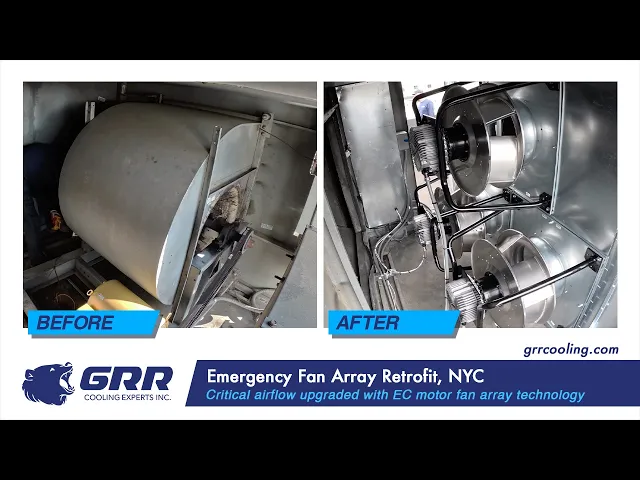
This recent emergency retrofit example shows how hospital HVAC response in NYC can shift from repair to retrofit when real field constraints shape the solution path, including airflow, power, fit-up, and the use of direct-drive EC fan array technology where appropriate.
Proof from recent hospital emergency work
CASE 1 / Recent emergency fan array (fan wall) retrofit in a Montefiore Radiology Center: supply fan modernization using three direct-drive EC motor fans designed around 15,000 CFM at 3.00” S.P. and matched to existing power conditions.
CASE 2 / Airflow restoration under urgent conditions: 48 hours, OR ventilation unit replacement, approximately 29,900 CFM restored. See the installation video>
CASE 3 / Live retrofit execution in a tight window: 7 hours, 30-ton rooftop unit retrofit completed and commissioned live. See the case>
For more proof, see All Case Studies>
Need help now? Call: +1 (718) 768-3740 or Request emergency evaluation via contact form
What we do and what we do not do
We do: | We do not: |
|---|---|
• Emergency response for hospitals and critical healthcare ventilation systems • AHU recovery, ventilation stabilization, and airflow continuity work • Engineering-led rapid retrofit when repair cannot be verified as reliable • Work inside tight windows (overnight, weekend, scheduled access blocks) • Emergency fan array retrofit planning when repair is not enough and real field conditions require a more practical recovery path | • Residential AC repair or home comfort service calls |
24/7 emergency response for hospitals and critical environments
Hospital HVAC failures are not standard building issues. The emergency is airflow stability, pressure relationships, and operational risk in critical zones.
Typical emergency scenarios:
AHU failure with loss of airflow or unstable ventilation performance
RTU failures impacting clinical areas
Fan or fan array failure reducing supply capacity or stability
Controls dependency failures causing repeated trips or alarm loops
OR or procedure-zone ventilation instability
In many older NYC facilities, an HVAC emergency becomes a retrofit problem once access, airflow, power, and restart conditions are reviewed in the field.
What qualifies as a hospital HVAC emergency
Treat it as an emergency if any of the following are true:
Airflow is lost or unstable in critical zones
Ventilation cannot be maintained to a safe and predictable condition
Pressure stability is at risk in sensitive areas
The system is tripping repeatedly or cycling without stable operation
A quick patch cannot be verified as reliable within the operating window
Emergency repair vs rapid retrofit: how we decide fast
In hospitals, the lowest-risk choice is not always repair. A patch that fails again is often the real cost.
We decide quickly using an engineering triage:
Stabilize the environment (airflow and critical ventilation first)
Confirm the failure mode (mechanical, electrical, controls, system interaction)
Assess reliability (can stable operation be verified)
Choose repair vs rapid retrofit
Emergency repair when performance can be verified and repeat-failure risk is low
Rapid retrofit when reliability cannot be verified or the system is end-of-life
Related planning guide: EC fan array retrofits in NYC hospitals and commercial buildings
That same repair-versus-retrofit logic also applies outside emergency conditions. Under Local Law 97, older NYC buildings may need to evaluate whether another repair is still a reliable long-term decision or whether a planned retrofit path makes more sense.
When EC fan arrays and EC motor technology become part of the retrofit path
In some emergency HVAC situations, a like-for-like repair is not enough.
If the existing fan system is old, hard to access, difficult to service, or no longer reliable, the better path may be a rapid retrofit using direct-drive EC fan technology.
EC fan arrays can support emergency retrofit planning because they can:
fit inside existing AHU sections
reduce belt-related maintenance issues
improve airflow control after restart
make future service access more practical
reduce dependence on one large fan assembly
For critical systems where one large fan creates a single point of failure, built-in redundancy may also become part of the retrofit decision. See GRR’s guide to built-in redundancy in EC fan array retrofits.
For facilities planning the next step after emergency stabilization, EC fan array retrofits in NYC hospitals and commercial buildings can support redundancy, serviceability, airflow control, and a more practical retrofit path inside existing AHUs.
The goal is not only to restore airflow. The goal is to bring the system back in a way that is more controllable, more serviceable, and better suited to the operating risk of the facility.
Engineering risk in hospitals: airflow, pressure, and operating rooms
Hospitals are not just another building type. HVAC is a safety-critical system.
Airflow continuity is the priority. A failure can disrupt ventilation performance and stability in ways that affect clinical operations.
Pressure control matters in critical areas. ORs and other sensitive zones depend on stable pressure relationships and predictable airflow behavior.
Verified performance beats fast restarts. The goal is stable operation with a reliable recovery path, not a temporary restart that fails again.
Emergency OR ventilation replacement proof>
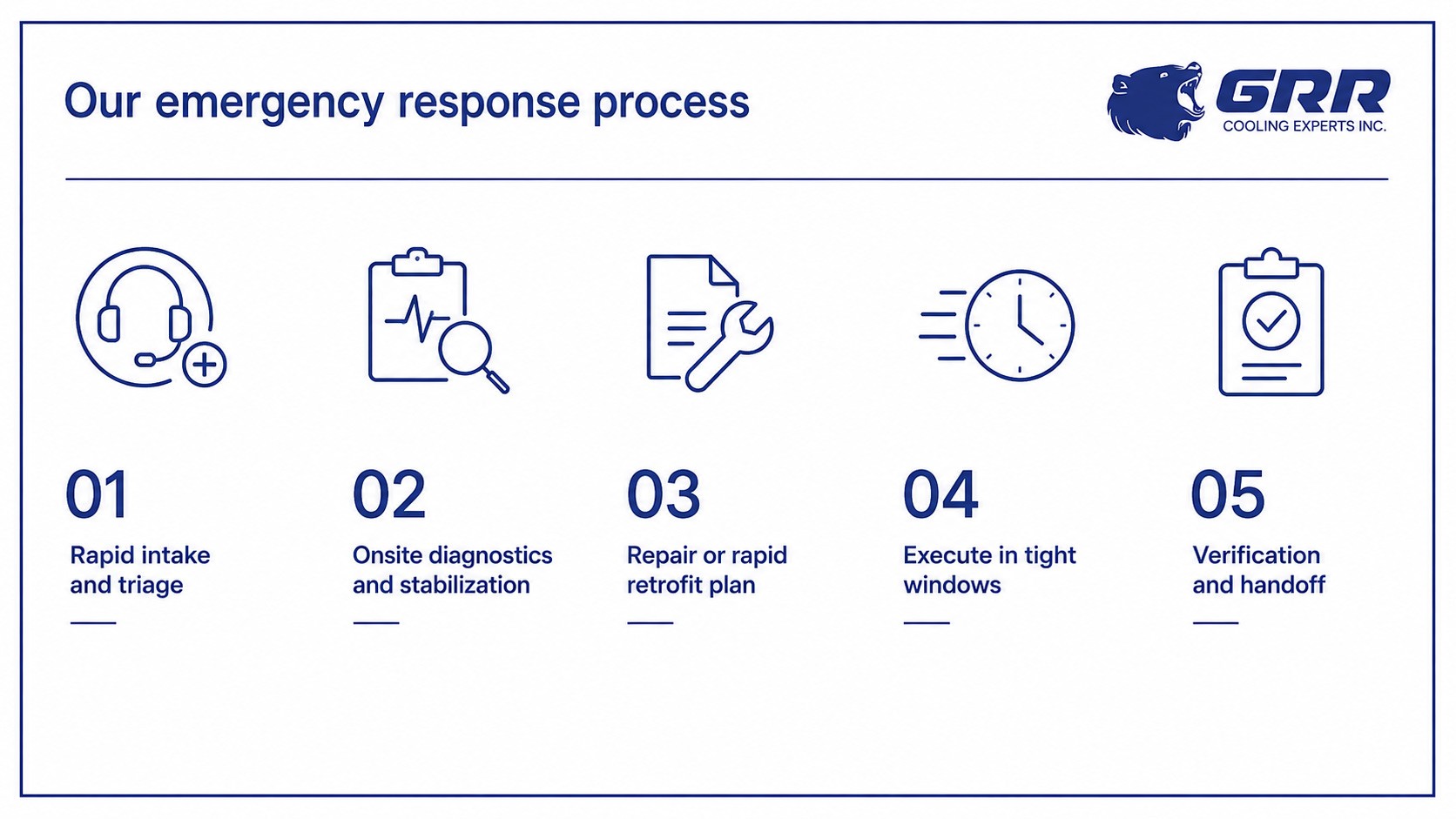
Our emergency response process
Step 1: Rapid intake and triage
Affected zones, constraints, access windows, risk areas.
Step 2: Onsite diagnostics and stabilization
Airflow delivery, controls dependencies, safe operating condition.
Step 3: Repair or rapid retrofit plan
Lowest-risk path based on verifiable performance.
Step 4: Execute in tight windows
Overnight and weekend sequencing, phased cutovers, coordination.
Step 5: Verification and handoff
Validated operation, documented actions, and next-step reliability plan. For deeper context, see how GRR approaches verified airflow after HVAC retrofit through controls response, balancing, commissioning, and restart checks.
Planning the next step after stabilization?
Use our NYC retrofit sequencing checklist to review access, controls dependencies, commissioning time, and time-offline risk before planning the next retrofit phase.
Equipment we support during emergency response
AHUs and ventilation sections (fans, coils, filtration interfaces, controls dependencies)
RTUs serving critical zones
Fan arrays and airflow modernization
Stabilization and verification support (TAB and commissioning coordination as needed)
NYC coverage: all five boroughs
We support emergency response and rapid retrofit work across:
Manhattan
Bronx
Brooklyn
Queens
Staten Island
These questions summarize the main decisions facility teams face during emergency HVAC response, from first stabilization to rapid retrofit planning.
____________________________________
FAQs
Q: How fast can GRR respond to a hospital HVAC emergency in NYC?
A: GRR prioritizes rapid triage based on the affected zones, risk level, access conditions, and operating schedule. The first goal is to stabilize airflow and critical ventilation, then confirm whether the system can be safely repaired or needs a rapid retrofit path.Q: Do you handle operating room ventilation emergencies?
A: Yes. Operating room and procedure-area ventilation issues require careful attention to airflow stability, pressure relationships, and verified performance. GRR focuses on stabilization first, then confirms the safest path for repair, replacement, or rapid retrofit.Q: What is the difference between emergency repair and rapid retrofit?
A: Emergency repair restores operation when performance can be verified and repeat-failure risk is low. Rapid retrofit is used when the failing system is unstable, difficult to service, near end-of-life, or cannot be trusted after a temporary repair. For non-emergency planning, use GRR’s AHU repair, retrofit, or replacement framework before the next failure narrows the decision window.Q: Do you support AHU and fan array failures in hospitals?
A: Yes. GRR supports AHU failures, fan failures, fan array issues, ventilation instability, and related controls dependencies. The response starts with airflow stabilization and failure-mode diagnosis, then moves toward a verified repair or engineered retrofit plan.Q: Can GRR work overnight or on weekends?
A: Yes. Many hospital and critical facility projects require overnight, weekend, or phased execution windows. GRR plans work around access, safety, coordination, and restart requirements to reduce disruption to active operations.Q: What should a hospital engineering team do first during an HVAC emergency?
A: Identify the affected zones, operational risks, alarm history, access limitations, and current system status. Avoid repeated resets without confirming the failure mode, especially when critical ventilation or pressure stability may be affected.Q: Does GRR provide a modernization plan after emergency stabilization?
A: Yes. Many emergency HVAC situations follow a stabilize now, modernize next path. After the immediate risk is controlled, GRR can define a rapid retrofit or modernization plan based on access, airflow, power, controls, and long-term reliability.Q: What areas of NYC does GRR cover for emergency hospital HVAC response?
A: GRR supports emergency hospital HVAC response and rapid retrofit work across New York City, including Manhattan, Bronx, Brooklyn, Queens, and Staten Island.
Request emergency evaluation
If you are dealing with an urgent hospital HVAC failure in NYC, we can help you stabilize airflow fast and choose the safest path between a verified repair and an engineered rapid retrofit.
——
Call GRR: +1 (718) 768-3740 or Request emergency evaluation via contact form