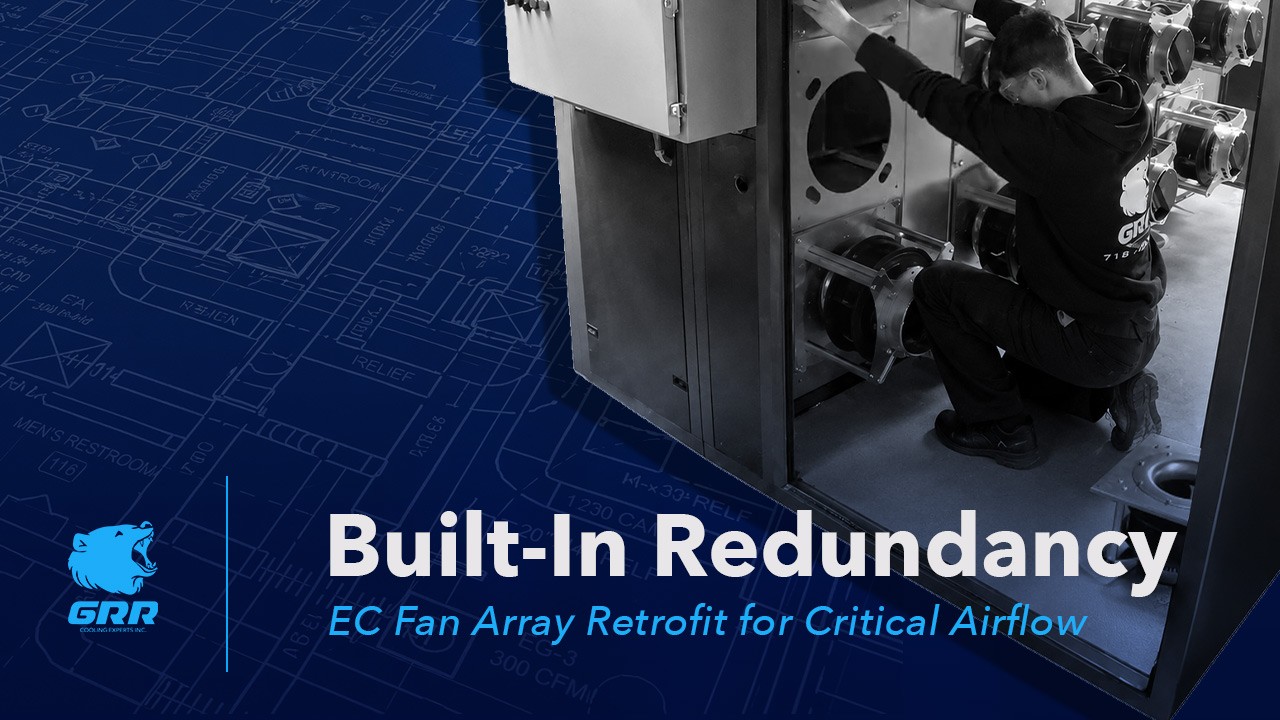
EC Fan Array Redundancy for Hospital HVAC Retrofits in NYC
Why built-in redundancy is becoming a stronger retrofit priority for hospitals, operating rooms, labs, and critical HVAC systems
In many older NYC buildings, one large fan still carries the full airflow load inside an existing air handling unit.
When that fan is working, the system may seem stable enough.
But when it fails, the building team may face a much bigger problem than a mechanical repair.
For hospitals, operating rooms, laboratories, and other critical environments, airflow supports more than comfort. It can affect pressure control, infection control, temperature stability, humidity control, and operational continuity.
Short answer: Built-in redundancy means the HVAC system is not fully dependent on one large fan. In an EC fan array retrofit, multiple direct-drive fan modules share the airflow load inside the existing AHU. If one fan has an issue, the system can often continue moving air while service is planned, depending on the design, controls, airflow requirements, and site conditions.
If your team is evaluating an aging AHU, fan section, or critical air system, start with the operating risk, not only the failed component. See HVAC retrofit services in NYC.
Short educational video explaining how EC fan array redundancy can reduce single-fan failure risk and support critical airflow continuity in hospital HVAC retrofits.
The problem: one large fan can become one large risk
Many older air handling units still rely on large belt-driven fans.
These systems were often installed decades ago, before today’s expectations around energy use, controllability, access, serviceability, and redundancy.
In a typical older AHU, one large fan may carry the full airflow load.
That creates several risks:
if the motor fails, airflow can stop
if belts break, airflow can drop quickly
if bearings or shafts wear out, vibration can damage the unit
if parts are custom or obsolete, lead time can become a major problem
if access is tight, even a simple replacement can become a shutdown project
For a normal commercial space, this is already a serious issue.
For a hospital, lab, or operating room environment, it can become a larger operational risk.
A failed fan is not always just a mechanical repair. It can affect patient areas, procedure schedules, infection control requirements, pressure relationships, and facility operations.
That is why older AHUs often need more than a direct replacement.
They need a smarter retrofit strategy.
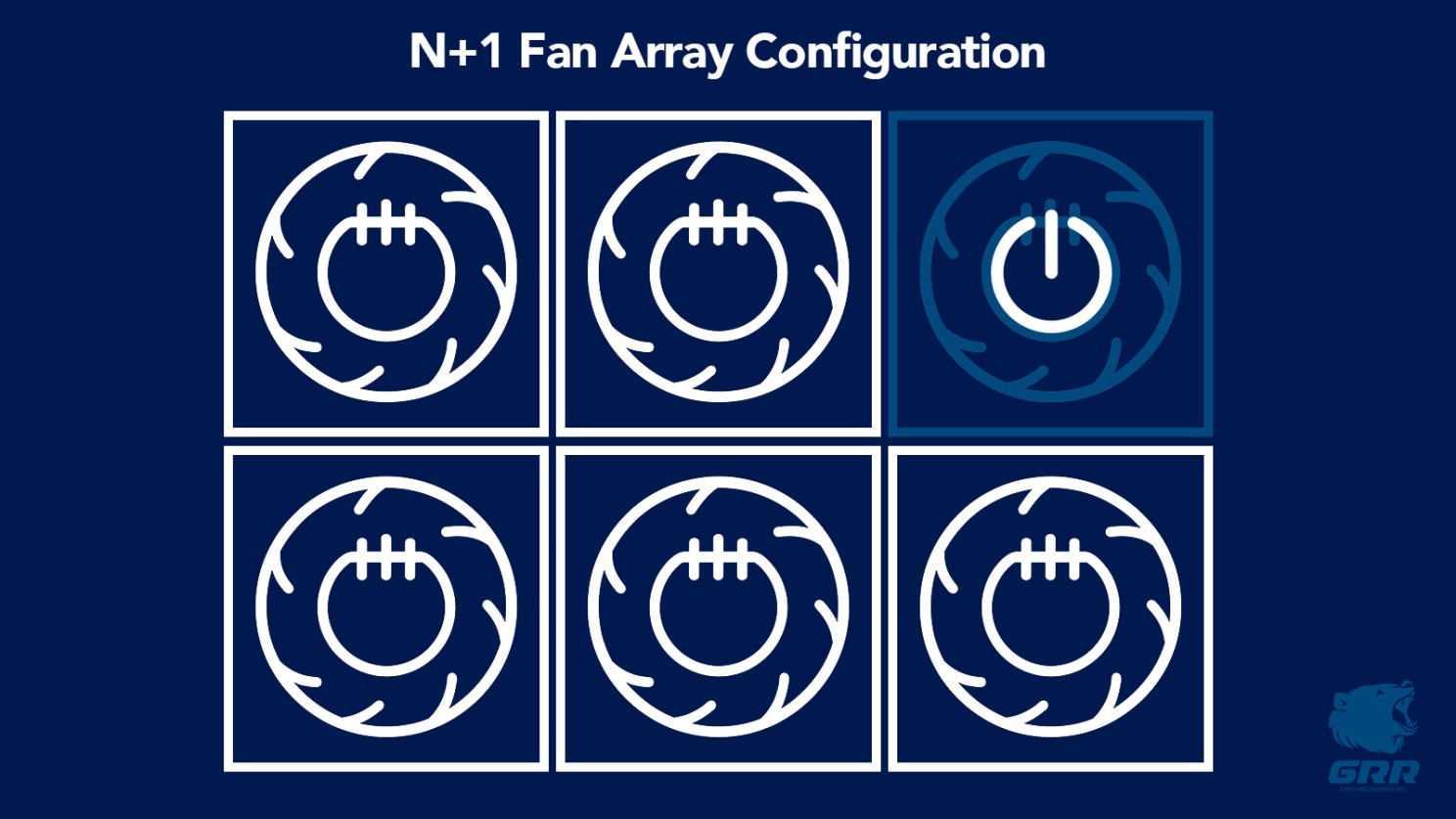
A schematic representation of EC fan wall redundancy (Image by GRR Cooling Experts)
Why redundancy matters in critical environments
In critical environments, airflow has a job.
It helps maintain pressure relationships between rooms. It supports air changes. It helps control temperature and humidity. In operating rooms and healthcare spaces, it can also support infection control strategy.
When one fan is responsible for the full load, the system has a single point of failure.
That means one mechanical issue can create a much larger operational issue.
Built-in redundancy helps reduce that risk.
Instead of relying on one large fan, an EC fan array uses multiple smaller fan modules working together. The system is designed so airflow is distributed across several direct-drive EC fans.
This gives facility teams more control and more service flexibility.
If one fan needs attention, the entire system may not need to be treated as a full emergency shutdown. Maintenance can often be planned with less disruption, depending on system design, airflow requirements, controls, and site conditions.
For facility managers and chief engineers, this is the real value:
Redundancy buys time.
It does not eliminate maintenance. It does not replace proper engineering, commissioning, controls, or balancing. But it can reduce the risk of one failed component becoming a full system failure.
For a broader planning view, see GRR’s guide to EC fan array retrofits, including when they make sense for NYC hospitals, commercial buildings, tight access conditions, and critical HVAC systems.
For a real hospital example of direct-drive EC fan wall work, see Lenox Hill Hospital HVAC Retrofit
The retrofit solution: EC fan arrays inside existing AHUs
An EC fan array retrofit replaces the old large fan assembly with a group of direct-drive EC fans installed inside the existing AHU cabinet or fan section.
This approach is especially useful in New York City because many mechanical rooms were not designed for easy equipment replacement.
In older buildings, access may be limited by:
narrow doors
tight corridors
low ceilings
existing ductwork
active hospital operations
limited shutdown windows
no practical crane access
mechanical rooms built around old equipment
A full AHU replacement may require cranes, street permits, temporary ductwork, long shutdowns, and major coordination.
An EC fan array retrofit can often avoid that path.
Instead of removing the entire unit, the existing fan section can be modified. The old fan assembly is removed in parts. A new fan wall or fan array is installed inside the existing AHU footprint. Controls, power, balancing, and commissioning are then completed around the actual site conditions.
That is where retrofit engineering matters.
This is not just equipment replacement.
It is field adaptation.
For related context, see Why NYC Buildings Are Switching to EC Fan Arrays
What built-in redundancy improves
Reliability
Multiple EC fans reduce dependence on one large rotating assembly. This helps lower the operational risk tied to a single motor, belt, shaft, or bearing failure.
Serviceability
Smaller fan modules are easier to access and replace than one large fan assembly. This can simplify future maintenance and reduce service complexity.
Operational continuity
In critical environments, keeping air moving matters. A fan array can give facility teams more options when one component needs service.
Controls
EC fan technology allows better speed control and system response compared with many older belt-driven configurations.
Maintenance reduction
Direct-drive EC fans remove belt maintenance from the fan system. That means no belt tensioning, belt replacement, pulley alignment, or belt dust inside the unit.
Energy performance
EC fan arrays can improve efficiency, especially when paired with proper controls and balanced airflow. The exact savings depend on the system, duty cycle, static pressure, and operating conditions.
Why this is especially relevant in NYC
NYC buildings create retrofit conditions that are different from new construction.
Many mechanical rooms were built decades ago. Some AHUs are located in penthouses, basements, ceiling spaces, interior rooms, or areas with poor access. In many cases, the original equipment was installed before the surrounding building conditions changed.
Relevant article: EC fan array retrofits in NYC hospitals and commercial buildings
That creates a common problem:
The old fan is failing, but removing and replacing it the traditional way may be too disruptive, too slow, or too expensive.
For hospitals and critical facilities, the decision is not only about equipment cost. It is about risk, shutdown planning, patient impact, and how quickly reliable airflow can be restored.
This is where EC fan array retrofits can make sense.
They allow the building to keep the existing AHU shell while upgrading the fan system inside it.
When access is the real constraint, see Why tight access turns a simple fan replacement into an HVAC retrofit
What facility teams often miss
One of the most common mistakes is treating redundancy as a product feature.
It is not.
Redundancy has to be engineered into the airflow, controls, electrical layout, service access, and commissioning plan.
The fan array itself is only part of the answer.
The retrofit has to work inside the real building conditions:
can the system deliver the required airflow?
can it fit inside the existing AHU?
can it be installed within the shutdown window?
can the controls support the required operation?
can the facility team service it after installation?
can the system be balanced and commissioned properly?
That is why a fan array retrofit should not be treated like a simple equipment swap.
The value comes from the full retrofit plan.
When this matters most
Built-in redundancy matters most when the HVAC system supports:
operating rooms
hospitals and healthcare facilities
laboratories
pharmaceutical spaces
critical ventilation environments
older AHUs with limited access
systems with high downtime risk
facilities with tight shutdown windows
buildings where one fan failure can affect operations
It also matters when the facility team is already concerned about aging belts, bearings, motors, shafts, obsolete parts, or repeated service calls.
At that point, another repair may restore operation.
But it may not reduce the risk.
In urgent healthcare situations, see Emergency hospital HVAC response in NYC
Repair logic vs redundancy retrofit logic
Repair logic
restore the failed component
minimize immediate disruption
keep the existing fan arrangement
solve the visible issue
return the unit to basic operation
Redundancy retrofit logic
reduce dependence on one large fan
improve controllability
simplify future service
remove belt-related maintenance
improve restart confidence
make the next operating cycle more predictable
Both paths can be valid.
The important part is knowing which decision the facility is actually making.
For downtime planning context, see EC vs AC Fans in NYC: Time Offline
What GRR Cooling Experts focuses on
GRR Cooling Experts works on HVAC retrofit projects where access, timing, reliability, and airflow performance matter.
For hospital and commercial building retrofits in NYC, the goal is usually not just to install new equipment.
The goal is to keep the building operational while improving reliability, serviceability, control, and energy performance.
A successful retrofit should answer four questions:
can the system deliver the required airflow?
can it fit inside the real building conditions?
can it be installed within the available shutdown window?
can the facility team service it more easily after the retrofit?
Built-in redundancy is part of that answer.
It gives older AHUs a more resilient fan system without always requiring full unit replacement.
For more field examples, see GRR HVAC retrofit case studies
Common mistakes in EC fan array redundancy retrofits
Treating redundancy as only a product feature
Redundancy is not just about adding more fans. It has to be engineered into the airflow, controls, electrical layout, service access, and commissioning plan.
Comparing EC fans only by efficiency
Efficiency matters, but in critical environments, reliability and serviceability may be just as important.
Ignoring access conditions
A solution that works on paper may fail in the field if the team does not account for doors, corridors, rigging, shutdown timing, and existing ductwork.
Skipping proper balancing and commissioning
A fan array must be tested and balanced after installation. Without proper commissioning, the system may not deliver the expected result.
Assuming every AHU is a good retrofit candidate
Not every system should receive the same solution. The right path depends on cabinet condition, airflow needs, static pressure, controls, electrical conditions, access, and operating risk.
Related reading
FAQ
Q: What is built-in redundancy in an HVAC fan system?
A: Built-in redundancy means the system has more than one fan or fan module supporting the airflow load. In an EC fan array, several fans work together instead of relying on one large fan.
Q: Why is redundancy important in hospital HVAC systems?
A: Hospitals rely on airflow for more than comfort. Airflow can support pressure control, infection control, temperature control, humidity control, and safe operation of critical spaces.
Q: Does an EC fan array prevent all downtime?
A: No. It does not remove the need for maintenance or repair. But it can reduce the risk of one failed fan causing a full airflow shutdown, depending on system design and site conditions.
Q: Can an EC fan array fit inside an old AHU?
A: Often, yes. Many retrofits are designed to fit inside the existing AHU cabinet or fan section. This depends on available space, airflow requirements, static pressure, access, and electrical conditions.
Q: Is an EC fan array better than replacing the full AHU?
A: Not always. Full AHU replacement may be the right solution in some cases. But when access, shutdown time, budget, or building disruption are major concerns, an EC fan array retrofit can be a practical alternative.
Q: What is the main benefit for facility managers?
A: The main benefit is risk reduction. A properly designed fan array can improve reliability, simplify service, reduce belt maintenance, and give the facility team more control over critical airflow systems.
Q: Is redundancy the same as backup equipment?
A: Not exactly. Backup equipment usually means a separate standby system or spare component. Built-in redundancy means the fan system itself is designed with multiple fan modules so airflow is not dependent on one large fan.
Q: What makes redundancy harder in older NYC buildings?
A: Common challenges include restricted access, older AHU cabinets, limited shutdown windows, existing ductwork, electrical constraints, and controls dependencies that affect installation and restart.
Conclusion
In older NYC buildings, HVAC retrofit decisions are rarely simple.
A failing fan may look like a mechanical problem, but in a hospital or critical facility, it can become an operational risk.
Built-in redundancy changes the conversation.
Instead of replacing one aging fan with another single point of failure, an EC fan array retrofit can give the system multiple fan modules, better service access, improved control, and a stronger reliability profile.
For critical environments, that matters.
Because when air supports health, safety, and operations, one fan failure should not decide the outcome.
Need help evaluating an aging AHU or fan system in a NYC hospital, lab, or commercial building?