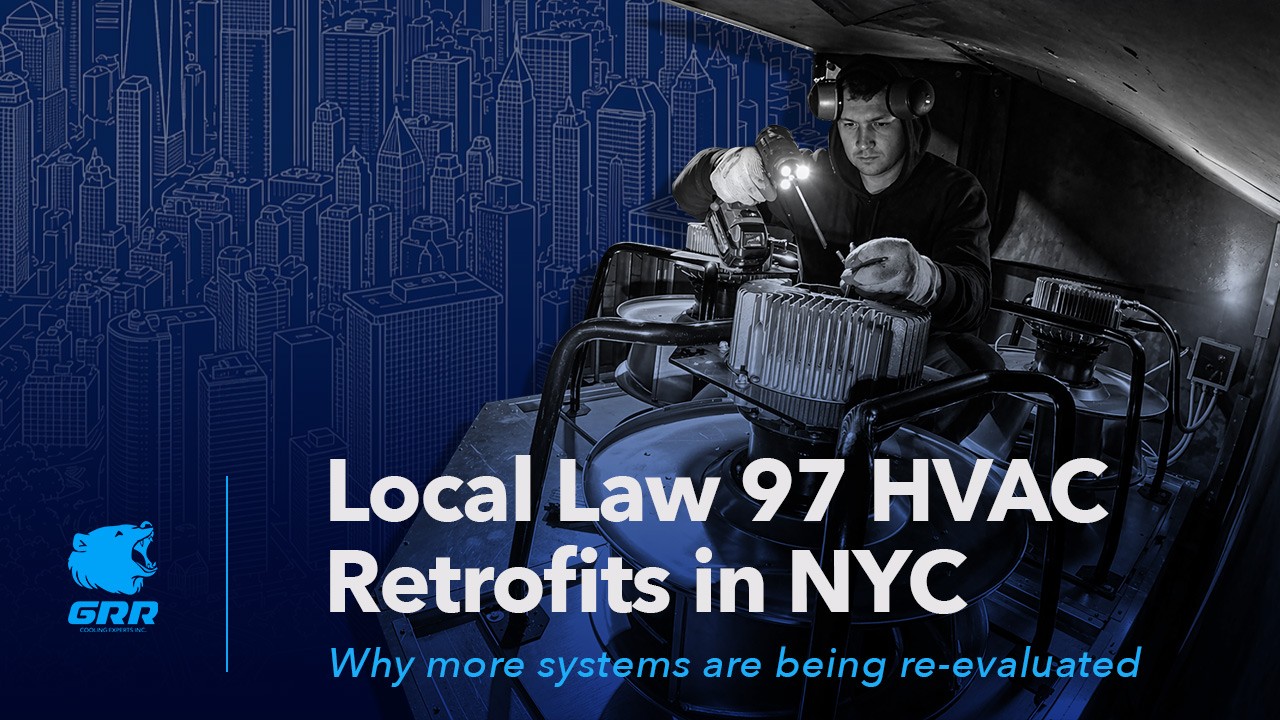
Local Law 97 and HVAC Retrofit in NYC: Where EC Fan Upgrades Make Sense
Why compliance pressure is pushing more NYC building teams to look harder at retrofit decisions, not just repairs
For many building teams in New York City, Local Law 97 is changing how older HVAC systems are evaluated.
What used to be postponed as a repair-only decision is now being looked at more closely through a different lens: energy use, controllability, serviceability, and how long an aging system can keep operating without becoming a bigger liability.
That does not mean every building needs a full HVAC replacement.
But it does mean more facility teams are asking harder questions about where retrofit work makes more sense than another temporary fix, especially when older fan sections, inefficient drive systems, or hard-to-service airside equipment are part of the problem.
Short answer: Local Law 97 is pushing more NYC building teams to evaluate HVAC retrofit paths that improve efficiency and control. In many cases, EC fan upgrades become part of that conversation because they can reduce energy use, improve controllability, and fit better into constrained retrofit conditions. The right answer still depends on the building, access path, controls, and shutdown reality.
If your team is evaluating whether an older system should stay on a repair path or move toward modernization, start with the broader retrofit context, not just the failed component. See HVAC retrofit services in NYC.
Why Local Law 97 is changing HVAC conversations
Local Law 97 is putting direct pressure on how buildings think about energy performance.
For older mechanical systems, that pressure often lands on equipment that has already been running with limited efficiency, limited control, and limited service flexibility for years. In many buildings, the system still runs, but it does so with older fan arrangements, belt-driven components, limited turndown control, and maintenance needs that keep adding friction over time.
That is where the conversation starts to shift.
A building team may not be looking for a major capital project. They may simply be trying to solve a reliability issue, reduce energy exposure, or avoid another cycle of patchwork repair. But once LL97 enters the discussion, the evaluation changes. The system is no longer judged only by whether it runs. It is judged more by how efficiently, how predictably, and how sustainably it can keep running.
Why fan and airside retrofit work gets more attention
In many older buildings, fan sections are one of the places where retrofit logic becomes easier to justify.
That is because fan energy, controllability, and maintenance burden affect daily system performance more than many building teams realize. Older belt-driven arrangements may still operate, but they often come with higher maintenance load, lower control precision, and less flexibility during restart or balancing.
That does not make every older fan system a bad system.
It does mean that once a building is under pressure to improve performance, the fan section becomes a reasonable place to re-evaluate the setup, especially when the existing arrangement is already creating operating headaches.
In retrofit terms, that usually brings attention to:
energy consumption under part-load conditions
controllability during balancing and recovery
maintenance exposure over time
fit within older mechanical layouts
serviceability after installation
Where EC fan upgrades can make sense
EC fan retrofit is not only about energy savings.
That is part of the value, but not the whole story.
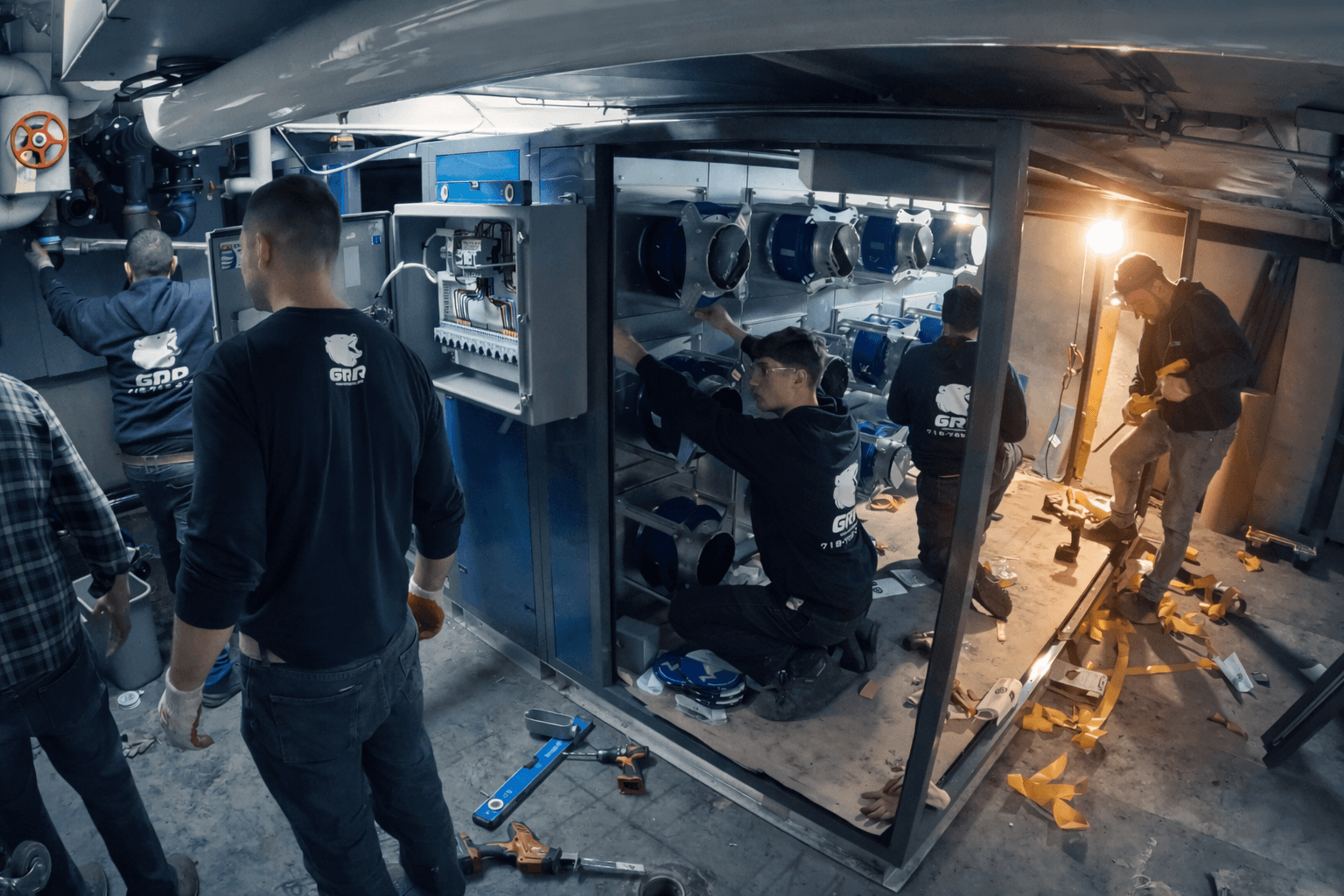
In the right retrofit context, EC technology can also help because it gives building teams better control, cleaner speed adjustment, and a more compact path where older replacement logic becomes difficult.
In many older NYC buildings, the real issue is not only the fan itself. It is the combination of energy pressure, access limits, service burden, downtime risk, and restart confidence.
When older belt-driven fans are part of the energy and serviceability problem, EC fan arrays can become one practical retrofit path. For a broader explanation, see GRR’s guide to older belt-driven fans to EC fan arrays.
When the existing fan section is inefficient and difficult to control
If the system still depends on older drive logic or limited speed control, retrofit can improve operating flexibility and make airflow adjustment more practical.
When the building needs a more serviceable long-term setup
A building team may be less interested in new technology and more interested in reducing maintenance headaches, belt-related service burden, and recurring downtime risk.
When retrofit space is constrained
In older NYC buildings, access path and fit-up matter. Compact retrofit solutions can become part of the answer where like-for-like replacement is harder than it looks on paper.
When the building is under both reliability and efficiency pressure
This is where LL97 often changes the conversation. A repair may restore operation, but a retrofit may make better sense if the system is already expensive to run, hard to control, or increasingly difficult to trust.
What facility teams often miss
One of the most common mistakes is treating LL97 as if it only creates an energy conversation.
It does not.
In practice, it often creates a decision-quality conversation.
The building team starts asking:
Is this system still worth patching?
If we repair it again, what are we really buying?
Are we solving only the failure, or are we improving the operating condition?
If a retrofit is needed later anyway, are we delaying the right work?
That is where the difference between repair logic and retrofit logic becomes more important.
A repair may restore basic operation.
A retrofit may improve how the system performs, how it is controlled, how it is serviced, and how confidently the building can operate going forward.
This is also why the decision cannot be reduced to nameplate efficiency alone. In live retrofit conditions, time offline during AHU retrofit often matters more than the brochure comparison.
Short video: When repair becomes a retrofit decision
Local Law 97 does not automatically mean every older HVAC system needs to be replaced. But it does push facility teams to ask a better question: is another repair actually improving the system, or only keeping it running for now?
Related visual summary
We also prepared a short related visual deck on this topic for facility teams reviewing older HVAC systems under Local Law 97.
View the related visual summary>
This deck summarizes the same practical decision: when repeated HVAC repair stops improving reliability, control, serviceability, and long-term operating confidence.
For related retrofit planning context, see the full related reading section below.
Why the field reality still matters
Even when LL97 pushes a building toward retrofit thinking, the decision still has to survive field reality.
That is especially true in New York City.

Older buildings often bring real constraints that do not show up cleanly in a simple planning discussion:
restricted access paths
limited staging space
difficult removal conditions
older duct geometry
controls dependencies
tight shutdown windows
occupied-building constraints
That is why no compliance-driven HVAC decision should be made as a pure brochure exercise.
The building may support the retrofit financially and operationally in theory. But the actual path still depends on how the work can be executed inside the real conditions of the building.
That is especially true in older buildings where access path, fit-up, removal sequence, and restart stability can reshape the entire job. Related reading: tight-access HVAC retrofit planning.
In that sense, Local Law 97 may create the pressure to act. The field condition still decides how the work gets done.
Field example: Lenox Hill Hospital
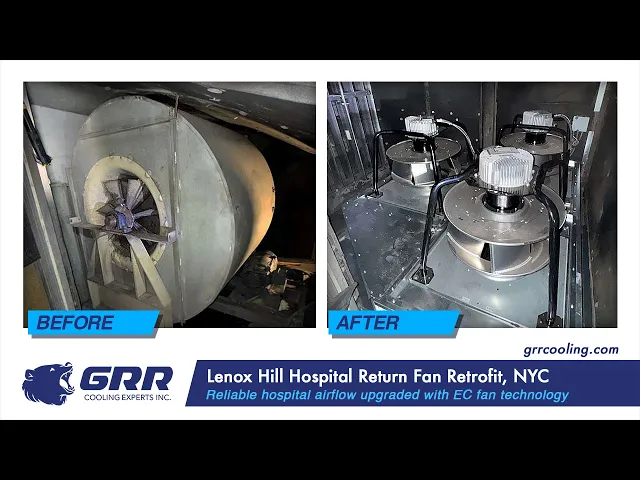
In one recent NYC hospital retrofit, GRR replaced an older return fan arrangement with a direct-drive EC fan wall solution under real existing-condition constraints. The value was not only efficiency. It was improved airflow control, better restart confidence, and a more serviceable long-term setup inside a live healthcare environment.
See full case study
EC retrofit is not the answer in every case
Not every system needs an EC retrofit.
And not every building gets the same value from it.
There are cases where a repair is still reasonable. There are cases where a broader system issue makes a partial upgrade less attractive. There are also cases where access, budget, controls condition, or equipment age change the best path.
That is why the smarter question is not:
Should every building switch to EC?
The smarter question is:
Where does EC retrofit create practical value in this building, under these constraints, with this operating reality?
That is the level where useful retrofit planning begins.
Common mistakes in LL97-driven HVAC decision-making
Treating LL97 as only an energy penalty issue
The law may start the conversation, but the actual decision often depends on reliability, controllability, service burden, and building constraints too.
Looking only at theoretical savings
Savings matter, but so do access, fit-up, controls compatibility, shutdown timing, and the long-term operational result.
Treating retrofit like a simple equipment swap
In older buildings, installation path, removal sequence, and restart logic often decide whether the work goes smoothly or becomes much harder than expected.
A compliance-driven evaluation still breaks down if the project is scoped around assumptions instead of actual building conditions. Related: 3 HVAC retrofit mistakes that break projects in NYC buildings.
When this matters most
This kind of retrofit evaluation matters most in:
older commercial buildings in NYC
hospitals and healthcare facilities
labs and critical ventilation environments
buildings with limited shutdown windows
systems with aging fan sections and poor serviceability
buildings where maintenance burden and energy pressure are rising at the same time
It also matters when a building team has already reached the point where another repair feels easier in the short term, but harder to justify in the bigger picture.
In hospitals and other critical environments, the line between repair and retrofit can narrow quickly when reliability cannot be verified. See emergency hospital HVAC response in NYC.
Repair logic vs retrofit logic
Repair logic
restore operation
minimize immediate spend
solve the visible failure
keep the existing arrangement in place
Retrofit logic
improve how the system operates going forward
reduce energy and maintenance burden
improve controllability
evaluate serviceability and restart confidence
make the next operating cycle more predictable
Both paths can be valid.
The important part is knowing which decision the building is actually making.
What this means for NYC facility teams
For facility managers, chief engineers, and building decision-makers in New York City, Local Law 97 is increasing the value of earlier HVAC evaluation.
The benefit is not just compliance planning.
It is better decision timing.
When fan systems, airside layouts, or older AHU sections are evaluated before the next emergency, the building gets more options. When the conversation starts only after a failure, the decision window gets narrower, and the work becomes more reactive.
That is why more building teams are starting to look at retrofit earlier, especially in systems where energy pressure, age, and operating risk are already moving in the same direction.
Related reading
Why tight access turns a simple fan replacement into an HVAC retrofit
3 HVAC retrofit mistakes that break projects in NYC buildings
FAQ
Q: Does Local Law 97 mean every building needs an HVAC retrofit?
A: No. LL97 does not automatically mean every system must be retrofitted. But it does push more building teams to evaluate whether older HVAC systems still make sense to keep repairing without improving efficiency or control.
Q: Why do EC fan upgrades come up in LL97 conversations?
A: Because EC technology can help reduce fan energy use, improve control, and support better retrofit outcomes in older systems. In many buildings, that makes it part of a practical efficiency and modernization discussion.
Q: Is EC retrofit only about saving energy?
A: No. Energy savings are important, but so are controllability, serviceability, fit within retrofit constraints, and how predictably the system performs after restart.
Q: When is a repair still the better choice?
A: A repair can still make sense when the system is otherwise in good condition, the operating burden is manageable, and the building does not gain enough practical value from a broader retrofit.
Q: What makes HVAC retrofit harder in older NYC buildings?
A: Common issues include restricted access, older duct layouts, limited shutdown windows, difficult fit-up, and controls dependencies that complicate installation and restart.
Q: What is the main mistake building teams make when evaluating retrofit under LL97?
A: One of the main mistakes is looking only at theoretical energy savings while underestimating the importance of access, controls, serviceability, and the real field condition of the building.
Conclusion
Local Law 97 is not changing every HVAC decision in the same way.
But it is pushing more NYC building teams to ask a better question:
Should this system simply be repaired again, or is this the point where retrofit starts making more sense?
GRR’s commercial AHU decision framework helps facility teams compare repair, retrofit, and full replacement before budget, downtime, and equipment scope are locked in.
That is where good planning becomes more valuable.
The strongest retrofit decisions are not driven by compliance language alone. They are driven by building reality, operating goals, and a clear understanding of where better efficiency, better control, and better long-term serviceability actually matter.
For proof from live retrofit work in NYC hospitals and critical facilities, visit GRR case studies.
Need help evaluating whether an older HVAC system should stay on a repair path or move toward retrofit?
Request an engineering site assessment