How to Decide Whether to Repair, Retrofit, or Replace a Commercial AHU in NYC
A practical decision framework for facility teams evaluating aging air-handling units, repeated failures, downtime risk, and long-term system value
When an aging air-handling unit develops another motor, bearing, fan, or controls problem, the immediate priority is usually to restore operation.
That does not automatically mean another repair is the right long-term decision.
The failure may be isolated. It may show that one AHU section has become the main operational weakness. Or it may be one more sign that the entire unit is approaching the end of its useful life.
For facility teams in New York City, the choice is rarely based on equipment age alone. Existing conditions, limited access, short shutdown windows, controls readiness, and the condition of the surrounding AHU sections can change the answer.
Short Answer
A commercial AHU should usually be repaired when the failure is isolated and the rest of the unit remains sound. A targeted retrofit may be better when one section has become unreliable but the AHU still has useful life. Full replacement should be considered when deterioration affects multiple sections or the unit can no longer support long-term operating needs.

Image: Repair, retrofit, or replace? GRR Cooling Experts’ decision framework for evaluating aging commercial AHUs in New York City based on equipment condition, reliability risk, access, downtime, and long-term operating needs.
The Decision Should Start With System Condition, Not Age
The age of an AHU matters, but it does not provide the full answer.
Two units of the same age can be in very different condition.
One may have a sound casing, serviceable coils, stable controls, and an isolated motor failure. Another may have corrosion, damaged drain pans, recurring fan problems, obsolete controls, and airflow that no longer meets the building’s needs.
That is why the first question should not be:
How old is the AHU?
A more useful question is:
What is actually failing, and how much of the existing system still has practical value?
The answer usually falls into one of three categories:
An isolated component failure
A section-level weakness
Broader AHU decline
When Repair Still Makes Sense
Repair is usually the fastest and least disruptive option.
It can be the right choice when the problem is limited to one serviceable component and the surrounding system remains in acceptable condition.
Examples may include:
one motor failure
a worn bearing
a damaged belt or drive
an isolated sensor problem
a local electrical fault
one failed control component
Repair is easier to justify when:
replacement parts are available
the fan assembly remains mechanically sound
the AHU still delivers the required airflow
controls remain stable
the failure has not become part of a recurring pattern
the repair does not leave another major weak point in place
A well-planned repair can restore service and extend equipment life without creating a larger project than the situation requires.
The problem begins when repair becomes the default response to every new failure.
One motor is replaced. Then a bearing fails. Then the drive needs attention. Then alarms or control instability appear. Each individual repair may seem reasonable, but together they may show that the system has entered a repeated-failure cycle.
At that point, the question changes from:
Can this part be repaired?
to:
Will this repair produce stable operation, or only delay the next failure?
When a Targeted AHU Retrofit Is the Better Option
A targeted retrofit preserves the useful parts of the AHU and modernizes the section creating the greatest operational risk.
For aging fan systems, that may mean replacing a large belt-driven fan with a direct-drive EC fan array retrofit or another engineered fan-section solution.
A retrofit may be the strongest path when:
the AHU casing remains usable
coils, filters, dampers, and drain pans are still serviceable
the fan section is the main source of maintenance or failure
replacement parts are difficult to source
the building cannot tolerate a long shutdown
access makes full-unit replacement difficult
better control, redundancy, or serviceability is required
the existing AHU footprint can support modernization
the facility wants to extend useful life without replacing the complete unit
A targeted retrofit can improve:
fan reliability
speed control
service access
redundancy
maintenance planning
alarm visibility
BAS integration
energy performance
But retrofit technology is not automatically the right answer.
A modern fan section installed inside a badly deteriorated casing, damaged coil section, failing drain pan, or unsupported electrical system may solve one problem while leaving several others behind.
The rest of the AHU still has to justify the investment. In older New York buildings, tight access can turn a simple fan replacement into an HVAC retrofit because removal, fit-up, sequencing, and restart planning all become part of the scope.
When Full AHU Replacement Is More Responsible
Full replacement usually requires more capital, planning, access, and downtime.
It may still provide the strongest long-term result when the condition of the complete unit no longer supports a targeted repair or retrofit.
Replacement should be seriously considered when:
casing corrosion or leakage is widespread
the fan and coil sections both require major work
drain pans or internal surfaces are badly deteriorated
filtration requirements can no longer be met
the unit lacks space for required upgrades
electrical capacity is inadequate
controls are obsolete or difficult to support
repeated failures affect several AHU sections
the system cannot meet future airflow or pressure requirements
several separate retrofit projects would approach the cost of replacement
In these conditions, a fan-only retrofit may be technically possible but financially weak.
The facility may invest heavily in one section of an AHU that still has limited remaining life.
A new AHU may provide a cleaner platform for:
filtration
controls
airflow management
energy performance
service access
future maintenance
long-term capital planning
Two recent GRR projects show how full AHU replacement can take different forms depending on system size and field conditions. A 5,000 CFM hospital AHU replacement was engineered around existing ductwork, piping, electrical interfaces, and a limited shutdown window, while a 16,000 CFM AHU replacement with four EC blowers involved renewal of the filtration, heating, cooling, plenum, and blower sections as one complete air-handling system.
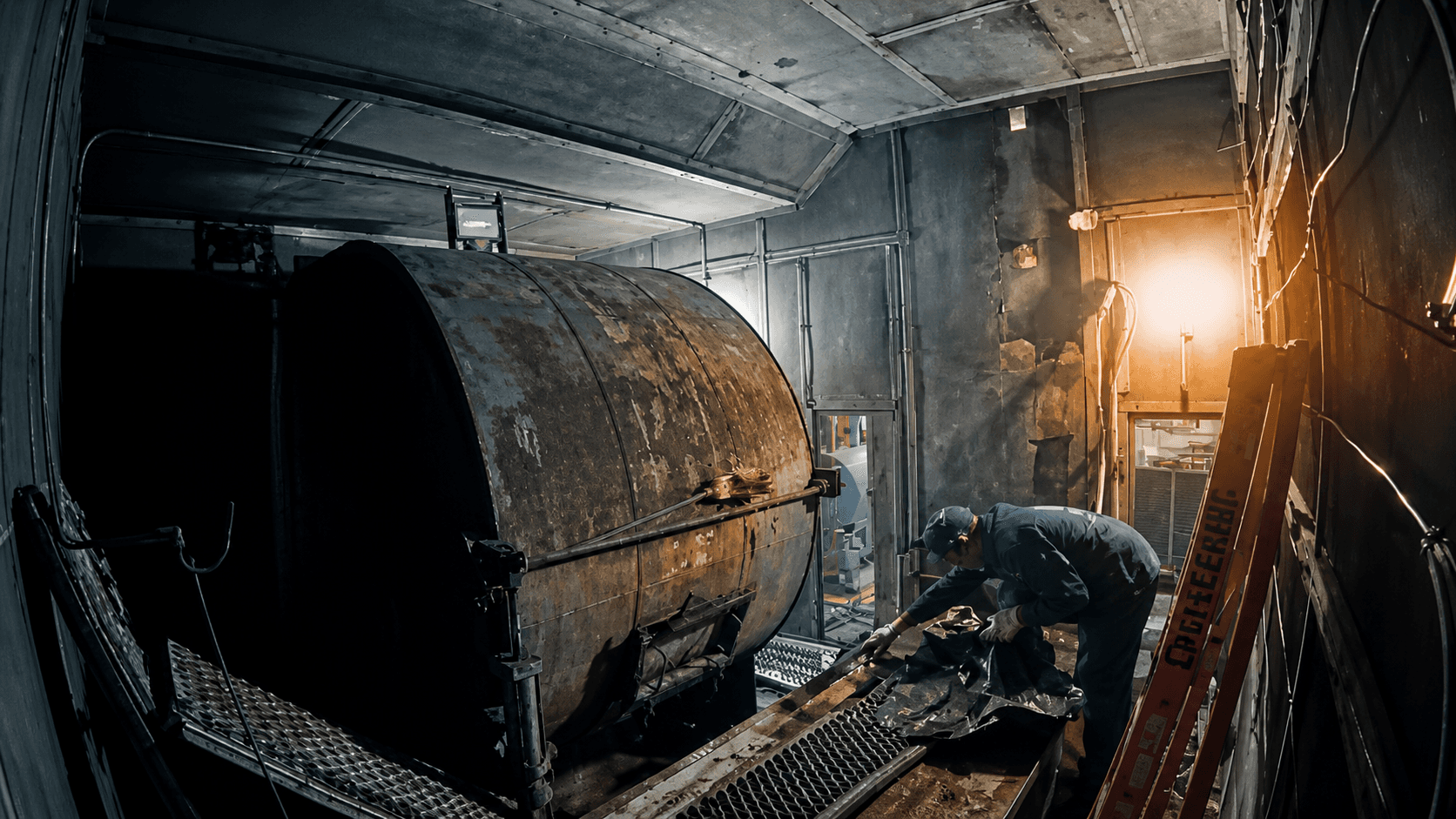
Image: Inspection of an aging commercial AHU showing wider equipment deterioration that may make full replacement more practical than another isolated repair. Image by GRR Cooling Experts.
Six Factors That Should Drive the Decision
1. What Is Actually Failing?
One isolated motor failure is different from a pattern involving fans, bearings, drives, controls, casing, and repeated airflow problems.
Review:
recent service calls
replaced components
recurring alarms
temporary fixes
downtime events
parts availability
A single event may support repair.
Repeated failures often point toward retrofit or replacement.
2. What Condition Is the Rest of the AHU In?
The failed component should not be evaluated separately from the complete unit.
The assessment should include:
casing
coils
filters
dampers
drain pans
fan section
electrical infrastructure
controls
service access
A targeted retrofit is easier to justify when the surrounding sections still have useful life.
3. Is the AHU Still Meeting the Building’s Needs?
An AHU may continue running while no longer delivering reliable performance.
Facility teams should review actual operating conditions, including:
airflow
static pressure
motor load
filter pressure drop
coil pressure drop
control response
alarm history
space conditions
maintenance history
A running unit is not automatically a healthy unit.
4. How Much Downtime Can the Building Tolerate?
Downtime can change the technical and financial answer.
A repair may fit into a short service visit.
A targeted retrofit may be completed during an overnight or weekend shutdown.
Full AHU replacement may require:
temporary ventilation
phased construction
major rigging
structural openings
a longer outage
coordination with occupied spaces
In hospitals, laboratories, and other critical environments, the best theoretical solution may not be the best executable solution.
The building has to support the plan.
5. Can the Existing Electrical and Controls Systems Support Modernization?
A modern fan section may require more than mechanical work.
The complete scope may include:
new power distribution
overload protection
speed control
control wiring
BAS integration
alarm logic
updated sequences of operation
startup testing
balancing and commissioning
If these requirements are identified late, a project that looked simple can expand during installation.
The full scope should be understood before equipment is ordered.
6. What Result Should the Project Deliver Over the Next Five to Ten Years?
The lowest initial cost is not always the lowest long-term cost.
Facility teams should compare:
repair frequency
maintenance burden
parts availability
downtime exposure
energy use
serviceability
remaining AHU life
planned building upgrades
future capital budgets
The better question is not:
What is the cheapest way to restart the unit today?
It is:
Which option gives the building the most stable and supportable result over the expected life of the project?
Why NYC Building Conditions Change the Answer
Commercial HVAC work in New York City often has to be planned around conditions that do not appear on an equipment schedule.
The original installation path may no longer exist.
Mechanical rooms may be surrounded by new piping, electrical systems, walls, ceilings, or active tenant spaces. Roof access may be restricted. Freight elevators and service corridors may limit equipment size. Shutdown windows may be measured in hours rather than days.
That means every option should be evaluated from two directions:
What does the system technically need?
What can the building physically and operationally support?
A full AHU replacement may look correct on paper but require major rigging, temporary systems, permits, structural work, and extended downtime.
A targeted retrofit may allow the facility to retain the usable AHU structure and solve the main reliability problem inside the existing footprint.
Access, removal path, sequencing, controls coordination, and restart planning are not secondary construction details.
They are part of the engineering decision.

Image: GRR Cooling Experts technicians evaluating equipment condition, controls, piping, and available installation space inside a constrained New York mechanical room.
A Targeted Retrofit in a NYC Hospital
In one New York hospital return-fan project, the selected path was a targeted retrofit rather than another repair or complete AHU replacement.
The existing AHU structure still had practical value, but the fan section had become the main operational weakness.
The project required:
removal of the existing fan assembly
custom intake and discharge transitions
a new electrical panel
individual overload protection
speed control
reconnection and sealing
startup
verification of stable operation
The retrofit allowed the facility to modernize the problem section without replacing the complete AHU.
The result depended on more than fan selection.
Access, fit-up, electrical work, controls, sequencing, and startup requirements had to be resolved before the shutdown began.
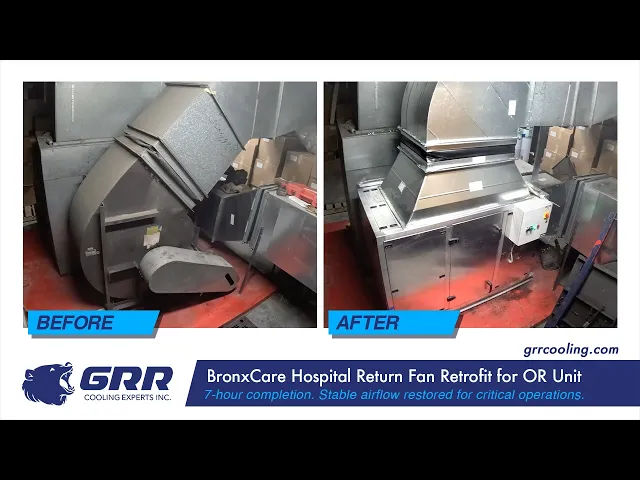
Video: Before and after: BronxCare Hospital OR-support return-fan retrofit completed within a seven-hour onsite window, delivering 12,000 CFM with two ECM fans, custom duct transitions, a new electrical panel, and verified stable operation. Video by GRR Cooling Experts.
Full project breakdown: BronxCare Hospital return-fan retrofit completed live in seven hours.
After installation, performance should be verified under actual operating conditions, including airflow, control response, alarms, balancing, and restart behavior.
Repair vs. Retrofit vs. Replacement
Condition | Repair | Targeted retrofit | Full replacement |
|---|---|---|---|
Failure scope | One isolated component | One section is the main weakness | Multiple sections are deteriorated |
AHU condition | Generally sound | Useful casing and surrounding sections | Limited remaining life |
Parts | Available | Difficult to source or no longer practical | Multiple obsolete systems |
Downtime | Short service window | Planned overnight or weekend work | Longer outage or phased project |
Controls | Stable | Controls need modernization | Full controls replacement likely |
Access | Simple component access | Modular installation may be required | Major removal and rigging required |
Best use | Restore an otherwise healthy system | Extend AHU life and solve a defined weakness | Reset the complete system |
Questions Facility Teams Should Ask Before Approval
Before approving repair, retrofit, or full replacement, confirm:
Is the failure isolated or part of a larger pattern?
What condition are the casing, coils, filters, dampers, and drain pans in?
Has actual airflow and static pressure been measured?
How often has the system required emergency service?
Are replacement parts still available?
What access path exists for removal and installation?
How much downtime can the building tolerate?
Can the electrical and controls systems support modernization?
How many years of useful life should the project provide?
Which option creates the lowest operational risk over that period?
Clear answers make the scope easier to defend technically and financially.
GRR FIELD GUIDE
Download GRR Field Problem Notes, Volume 1
Once a facility selects a retrofit path, the next challenge is execution. GRR Field Problem Notes, Volume 1 provides practical frameworks for access review, limited-shutdown sequencing, and verified restart in existing HVAC systems.
View / Download the Field Guide
Explore all GRR HVAC retrofit guides
Frequently Asked Questions
Should an old commercial AHU always be replaced?
No. Age alone does not determine the right path. An older AHU may still be a good retrofit candidate if the casing, coils, dampers, drain pans, and other major sections remain serviceable.
When does a fan replacement become an HVAC retrofit?
A fan replacement becomes a retrofit when the work requires changes to the fan section, supports, transitions, duct connections, electrical distribution, controls, access path, or startup sequence.
When is repeated repair no longer economical?
Repeated repair becomes less attractive when failures are becoming more frequent, parts are difficult to source, downtime is increasing, or each repair leaves another major weakness in place.
Can an EC fan array extend the life of an existing AHU?
It can when the existing casing and surrounding sections remain usable. A properly engineered EC fan array retrofit may improve reliability, controllability, redundancy, and serviceability without replacing the complete AHU.
What should be measured before selecting a retrofit?
At minimum, the assessment should review actual airflow, static pressure, motor load, equipment condition, access, electrical capacity, control requirements, and the available shutdown window.
How long does a commercial AHU retrofit take?
The timeline depends on access, equipment size, mechanical adaptation, electrical work, controls, and commissioning. Some targeted retrofits can fit into an overnight or weekend work window, while more complex projects require phased execution.
***
Choose the Project That Fits the Building
Repair addresses an isolated failure.
A targeted retrofit modernizes the section that has become the main operational weakness.
Full replacement resets the system when too many sections have reached the end of their useful life.
The best choice is not automatically the newest technology or the largest project.
It is the option that provides reliable, serviceable, and predictable operation within the real limits of the building.
GRR Cooling Experts provides commercial HVAC retrofit engineering and field execution for hospitals, laboratories, critical environments, and large commercial buildings across New York City and the Metro Area.
Planning an AHU upgrade?
Request an engineering site assessment