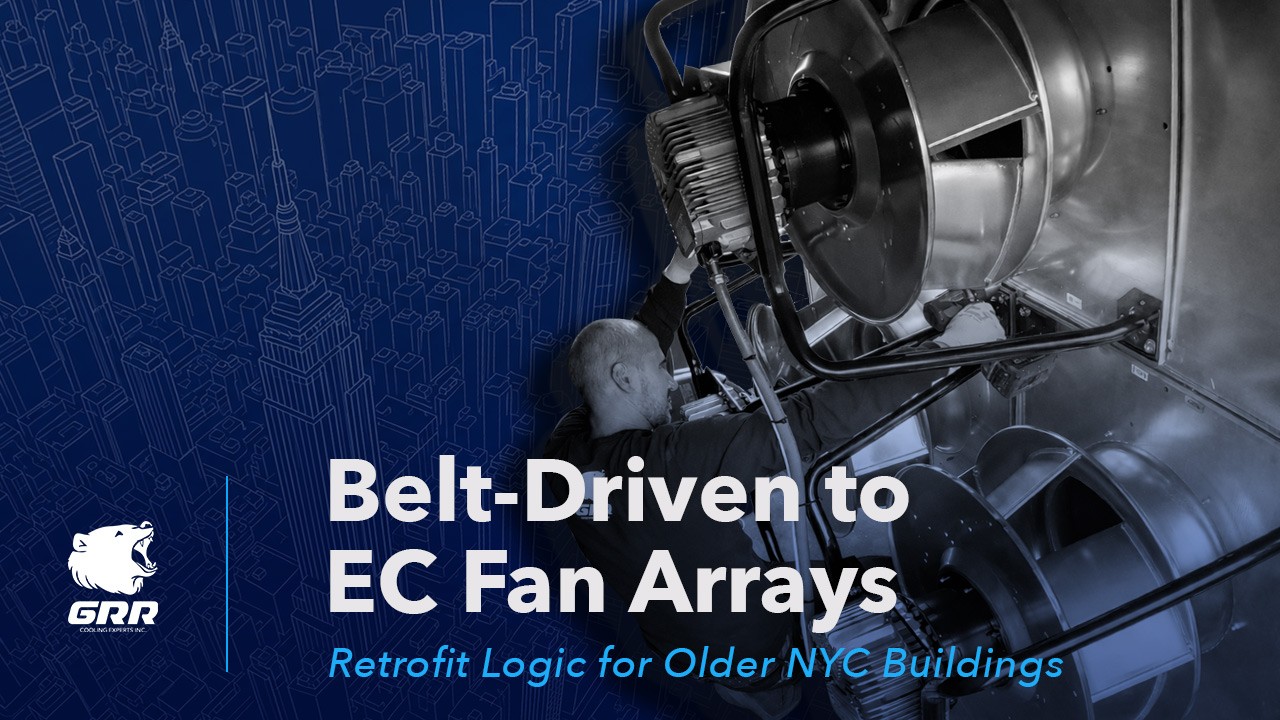
Why Older NYC Buildings Are Moving From Belt-Driven Fans to EC Fan Arrays
Belt-Driven Fans to EC Fan Arrays in Older NYC Buildings | GRR Cooling Experts
Older mechanical rooms in New York City rarely match modern HVAC retrofit requirements.
Many buildings still rely on belt-driven fans inside existing air handling units. These systems may still run, but they often create problems around airflow control, service access, maintenance, energy use, and shutdown planning.
That is why many facility teams are now evaluating EC fan arrays as a practical retrofit path for older NYC AHUs.
Short answer: EC fan arrays help older NYC buildings move away from large belt-driven fans by using multiple compact, direct-drive EC fan modules inside the existing air handler footprint. For many retrofit projects, this can improve control, serviceability, energy performance, and installation flexibility without forcing a full AHU replacement.
If your building is evaluating an aging fan system, start with the real retrofit conditions: access path, required airflow, static pressure, shutdown window, electrical conditions, and controls.
See our HVAC retrofit engineering services in NYC.
Why the shift is happening now
Older belt-driven fans were designed for a different operating reality.
Many were installed before today’s expectations around building energy performance, pressure control, serviceability, and fast retrofit execution. In New York City, the problem is often made worse by older mechanical rooms, narrow corridors, low ceilings, and AHUs that are difficult to access.
Facility teams are dealing with several pressures at once:
aging motors, belts, bearings, shafts, and pulleys
higher expectations for airflow stability
energy and carbon reduction pressure
limited shutdown windows
tight access paths inside older buildings
harder-to-source replacement parts
maintenance teams that need simpler service conditions
A traditional like-for-like fan replacement can still make sense in some buildings.
But in many older NYC AHUs, the issue is no longer just the fan.
The issue is the full retrofit condition.
Why older belt-driven fans create retrofit problems
Most older belt-driven fans depend on larger mechanical assemblies.
They often require more service space, more maintenance, and more mechanical components than modern direct-drive fan systems.
Common issues include:
belt wear and belt replacement
bearing and shaft problems
vibration
noise
limited airflow control
harder access for service
large parts that are difficult to move through existing buildings
When access paths are narrow, a basic fan replacement can become a larger retrofit project.
This is especially common in older Manhattan, Brooklyn, Bronx, Queens, and Long Island buildings where equipment may be surrounded by existing walls, ductwork, piping, or service constraints.
For a deeper look at this access issue, see why tight access turns a simple fan replacement into an HVAC retrofit.
The Real Cost of Staying With Belt-Driven Fans
The belt itself is usually not the most expensive part of a belt-driven fan system. The recurring cost builds around inspection, tensioning, alignment, replacement parts, emergency labor, lost airflow, and operational disruption.
In buildings with limited shutdown windows, repeated belt-related service can become more expensive than the individual repair suggests.
A direct-drive EC fan array removes belts as a recurring maintenance item. That does not make the system maintenance-free, and it does not mean every AHU should be retrofitted. The decision should still account for required airflow, static pressure, operating hours, access, electrical conditions, controls, commissioning, and the remaining condition of the AHU.
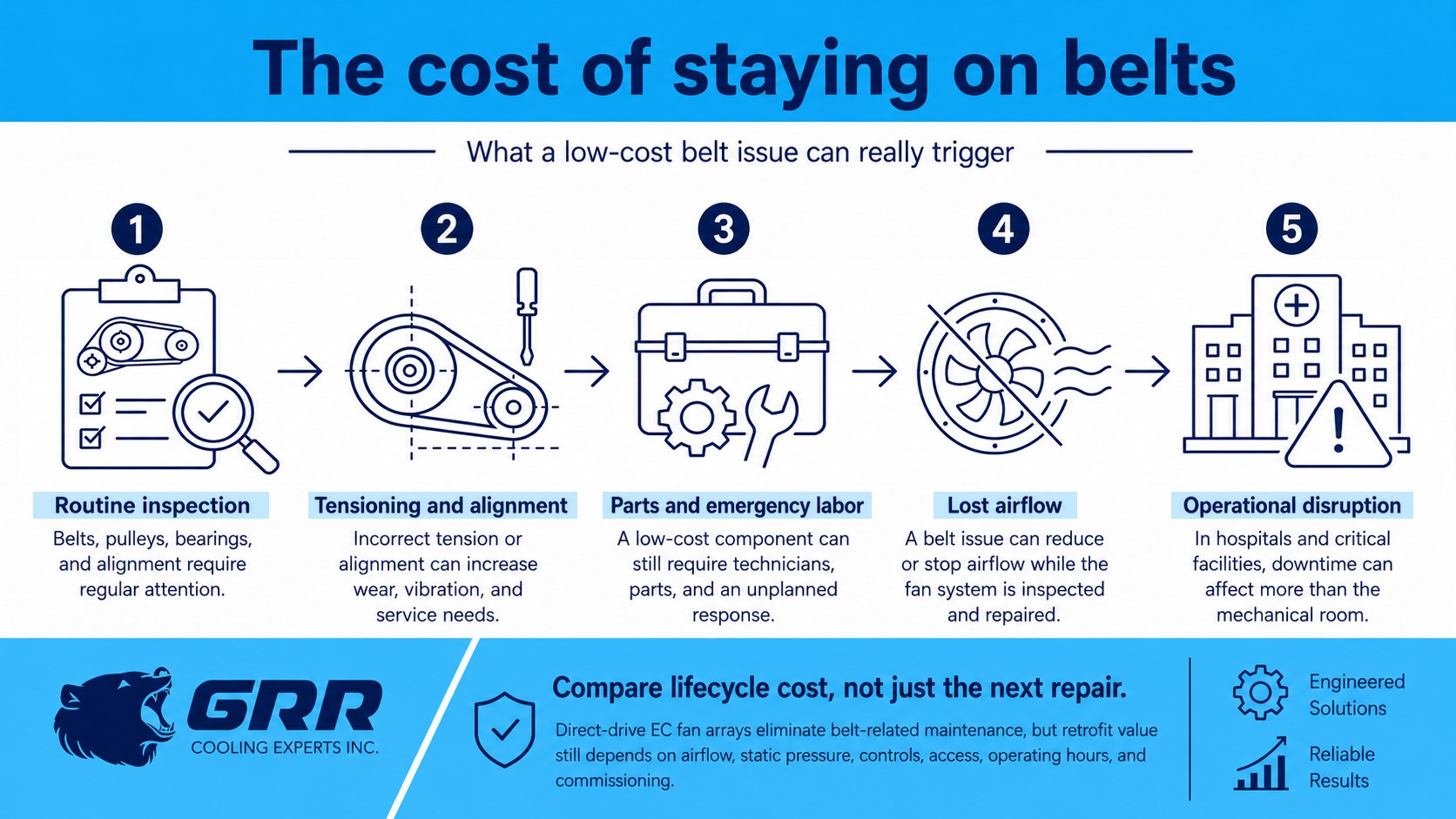
The better comparison is not belt price versus fan-array price. It is the total lifecycle cost and operating risk of each path.
Quick explainer: why EC fan arrays fit older NYC buildings
This 30-second video explains why older NYC buildings are moving from belt-driven fans to modular EC fan arrays. It highlights the main retrofit logic: old fan systems are often difficult to replace, difficult to service, and hard to fit inside tight mechanical rooms.
How EC fan arrays solve the older-AHU problem
EC fan arrays replace one large fan assembly with multiple compact direct-drive EC fan modules.
This changes the retrofit logic.
Instead of trying to remove and replace one large fan through limited building access, the retrofit can often be planned around smaller modules that are brought into the building and assembled inside the existing AHU.
Key advantages include:
compact modular fan sections
direct-drive operation
fewer belt-related maintenance issues
better airflow control
easier service access
lower mechanical complexity
improved retrofit flexibility inside existing AHUs
For many facilities, the main benefit is not just efficiency.
It is the ability to upgrade an aging fan system without turning the project into a full air handler replacement.
Traditional fan replacement vs EC fan array retrofit
Traditional fan replacement logic
A traditional fan replacement usually focuses on restoring the existing fan arrangement.
That can work when the building has good access, enough room for service, available parts, and a manageable shutdown window.
But in older NYC buildings, this path can become difficult when the existing fan is large, the access path is limited, or the AHU is surrounded by fixed building conditions.
EC fan array retrofit logic
An EC fan array retrofit looks at the full operating condition.
The question is not only:
“What fan failed?”
The better question is:
Can the building get a more controllable, serviceable, and efficient fan system inside the existing AHU footprint?
That is why EC fan arrays can make sense when the old system has:
access limitations
aging belt-driven components
service difficulty
airflow shortfalls
energy performance concerns
tight restart windows
long-term maintenance risk
For a broader engineering overview, see GRR’s guide to EC fan array retrofits in NYC hospitals and commercial buildings.
When repeated belt service becomes part of a larger failure pattern, the next decision may be whether to repair, retrofit, or replace the commercial AHU.
For downtime planning context, see EC vs AC fans in NYC and time offline.
Field proof: Lenox Hill Hospital EC fan wall retrofit
This Lenox Hill Hospital return fan retrofit shows the real field condition behind EC fan array upgrades in older NYC buildings.
The work involved upgrading an existing return fan section with a direct-drive EC fan wall solution inside a constrained AHU environment. It supports the same retrofit logic discussed in this article: older belt-driven fan systems are often difficult to access, service, and replace, while modular EC fan arrays can fit inside the existing air handler footprint.
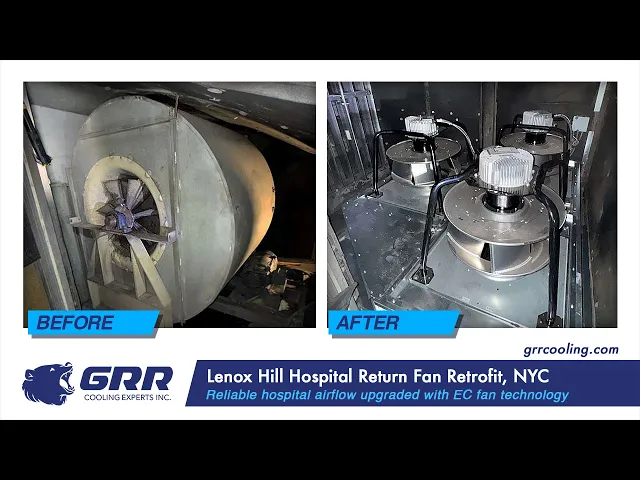
Watch more GRR installation videos on YouTube.
Reliability and service flexibility
EC fan arrays can also support built-in redundancy.
Instead of depending on one large fan, multiple EC fan modules can share the airflow load. This can reduce the risk of one fan issue affecting the full system, depending on the system design, controls, airflow requirements, and operating conditions.
For a deeper look at this reliability angle, see EC fan array redundancy for hospital HVAC retrofits in NYC.
This is one reason EC fan arrays are becoming a practical retrofit path for older NYC AHUs, especially when full equipment replacement is difficult, expensive, or disruptive.
Energy and building performance pressure
Energy performance is another reason facility teams are reviewing older fan systems.
New York City buildings face growing pressure to reduce energy waste and improve building system performance. In many older HVAC systems, fan energy is a meaningful part of the operating profile.
EC fan arrays can help because they allow more precise speed control and reduce belt-related mechanical losses.
This does not mean every building should replace its fan system immediately.
It means fan systems should be evaluated as part of a larger HVAC retrofit strategy.
For a deeper look at the compliance angle, see Local Law 97 HVAC retrofit planning in NYC.
Where EC fan arrays matter most
EC fan arrays are most relevant when the building has a combination of old equipment, limited access, and higher operating requirements.
Common environments include:
hospitals
laboratories
schools
commercial buildings
older office buildings
healthcare facilities
critical ventilation systems
buildings with tight mechanical rooms
AHUs with aging belt-driven fans
facilities with limited shutdown windows
In these buildings, the decision is rarely just about replacing a fan.
It is about keeping the building operational while improving airflow, controls, serviceability, and long-term reliability.
Field examples from GRR Cooling Experts
GRR Cooling Experts has installed EC fan arrays and direct-drive retrofit systems across a wide range of New York City building conditions.
Examples include:
hospital AHU retrofits completed inside active facility windows
healthcare fan array upgrades where older belt-driven systems were replaced with compact direct-drive fan modules
retrofit work where access limitations made traditional fan replacement difficult
commercial and institutional buildings where improved control and serviceability were part of the decision
These projects show why EC fan arrays are not just a product choice.
They are a retrofit strategy for buildings where access, timing, airflow, and service conditions all matter.
See GRR HVAC retrofit case studies.
How GRR evaluates EC fan array retrofit feasibility
GRR Cooling Experts starts with field conditions, not generic equipment assumptions.
A proper EC fan array retrofit review should include:
existing AHU condition
required airflow
static pressure
access path
fan section dimensions
duct layout
electrical conditions
controls requirements
shutdown window
balancing and commissioning plan
When the available shutdown window is measured in hours, access, fit-up, electrical readiness, controls coordination, startup, and verification should be planned as part of a controlled overnight HVAC retrofit.
Removing belts is only part of the result. Post-retrofit airflow verification, controls, and commissioning determine whether the upgraded system performs correctly after restart.
The goal is to understand whether an EC fan array is the right retrofit path for that specific building.
In some cases, a full replacement may be better.
In many older NYC buildings, a fan array retrofit can be a more practical path because it works inside the existing footprint and reduces the need for major building disruption.
Next steps for facility teams
If your building is evaluating an air handler upgrade, old belt-driven fan replacement, or EC fan array retrofit, start with a short feasibility review.
The most useful information includes:
existing fan type
AHU location
required CFM
static pressure
access limitations
shutdown window
current service problem
controls requirements
GRR Cooling Experts can review the existing system and help determine whether an EC fan array retrofit is a practical option.
Request a retrofit feasibility review
GRR Cooling Experts
Precision Retrofit Engineering for Critical Environments
FAQ: EC Fan Arrays in NYC Retrofits
Q: Why are older NYC buildings moving from belt-driven fans to EC fan arrays?
A: Older NYC buildings are moving to EC fan arrays because many existing belt-driven fans are difficult to access, maintain, control, and upgrade. EC fan arrays use compact direct-drive fan modules that can often be installed inside the existing AHU footprint.
Q: What is an EC fan array?
A: An EC fan array (aka "fan wall") is a group of electronically commutated direct-drive fans that work together inside an air handler. In the field, this type of system may also be called a fan wall or fan array.
Q: Is an EC fan array the same as a fan wall?
A: The terms are often used closely. A fan wall usually refers to the physical wall or grid of fans, while EC fan array describes the group of EC fan modules working together as the fan system.
Q: Why do EC fan arrays work well in older NYC buildings?
A: They are modular, compact, and direct drive. That helps when mechanical rooms have narrow doors, tight corridors, low ceilings, or limited access around the existing AHU.
Q: Can EC fan arrays reduce downtime?
A: In many retrofit conditions, yes. Because EC fan modules are smaller and can often be assembled inside the existing unit, the project may be easier to plan around short shutdown windows. The exact downtime depends on access, electrical work, controls, balancing, and site conditions.
Q: Do EC fan arrays improve energy efficiency?
A: They can. EC fan arrays allow better speed control and remove belt-related mechanical losses. Actual savings depend on airflow requirements, static pressure, operating hours, controls, and commissioning.
Q: Do EC fan arrays provide redundancy?
A: They can support built-in redundancy because multiple fan modules share the airflow load. If redundancy is a major concern, especially in hospital HVAC systems, the retrofit should be engineered around airflow requirements, controls, and service planning.
Q: Is every old AHU a good candidate for an EC fan array retrofit?
A: No. The right retrofit path depends on AHU condition, available space, airflow requirements, static pressure, electrical conditions, controls, and the available shutdown window.
Q: How does GRR evaluate whether an EC fan array retrofit makes sense?
A: GRR reviews the existing AHU, access path, airflow target, static pressure, electrical conditions, controls, and shutdown requirements. From there, the team can determine whether an EC fan array is practical or whether another retrofit path makes more sense.
Q: What costs should be included when comparing belt-driven fans with EC fan arrays?
A: The comparison should include routine inspection, tensioning, alignment, replacement parts, emergency labor, downtime exposure, airflow disruption, energy use, controls requirements, and expected equipment life.
Q: Do EC fan arrays eliminate all maintenance?
A: No. They eliminate belts and belt-related drive maintenance, but the fans, controls, electrical components, airflow performance, and overall AHU still require proper inspection and service.
Q: When does replacing another belt still make sense?
A: Belt replacement may remain appropriate when the failure is isolated, the fan assembly is mechanically sound, parts are available, airflow remains acceptable, and the repair does not leave a larger recurring reliability problem in place.