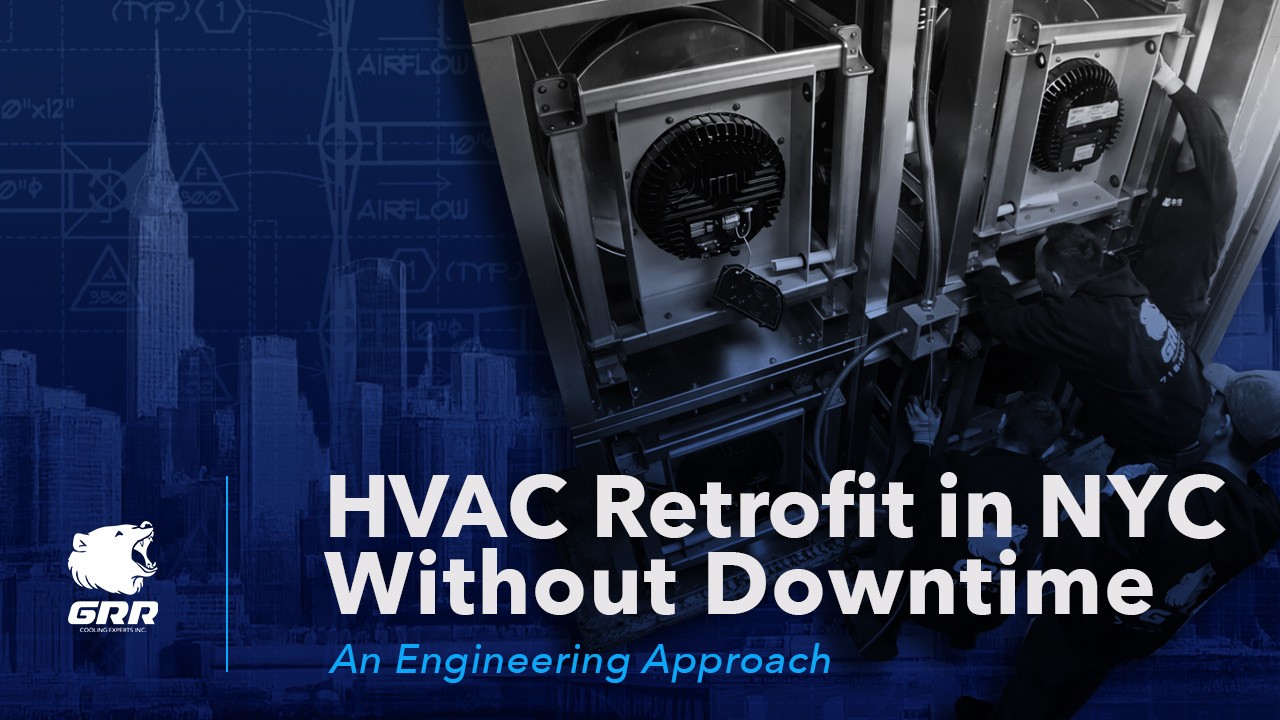
HVAC Retrofit in New York Without Full Shutdown | GRR
HVAC Retrofits in New York Are Defined by One Constraint: Downtime
This article is written for NYC facility decision-makers responsible for HVAC retrofits where airflow continuity cannot be compromised.
In hospitals, laboratories, and occupied commercial buildings across NYC, ventilation systems often cannot be fully shut down. Airflow is frequently required to remain available while retrofit work is being planned and executed.
This reality fundamentally shapes how HVAC retrofits are approached in New York City. Engineering decisions are driven not only by performance targets, but by operational risk, access limitations, and the requirement to maintain continuous airflow.
This article outlines a concept-level engineering approach used when HVAC retrofits must be planned without full system shutdowns. It also explains where modular EC fan arrays may be evaluated as part of a staged retrofit strategy.
Short Answer
Some HVAC retrofits in New York can be completed without a full system shutdown. The practical approach depends on mechanical access, airflow requirements, controls, building operations, and whether the work can be staged or completed inside a limited shutdown window.
If you are evaluating EC fan arrays as part of a retrofit strategy, start here: Why NYC Buildings Are Switching to EC Fan Arrays.
Final feasibility always depends on site-specific conditions.
Why Downtime Is a Core Risk in Critical Environments
Traditional HVAC retrofit methods often assume that systems can be taken offline.
In practice, this may involve:
full AHU shutdowns
extended installation windows
demolition inside active buildings
increased operational and safety risk
For many New York facilities, these assumptions are not operationally viable.
Hospitals, laboratories, and mission-critical buildings often operate continuously. Even short ventilation interruptions can affect safety, compliance, or daily operations. As a result, retrofit planning in NYC must focus on maintaining airflow continuity, not just replacing equipment.
See GRR HVAC retrofit engineering services for live NYC buildings.
Common Constraints in NYC HVAC Retrofit Planning
HVAC retrofits in New York are often shaped by a combination of constraints, including:
limited or no shutdown windows
live occupants and ongoing operations
phased scheduling requirements
coordination with controls and existing infrastructure
These factors require retrofit strategies that can adapt to real-world conditions rather than idealized installation scenarios.
Local Law 97 can add urgency to retrofit planning, but field conditions still determine what is technically practical. For older systems, the more useful question is whether another repair improves the operating reality or only delays a needed retrofit decision.
An Engineering Approach to Retrofit Planning Without a Full Shutdown
One option commonly evaluated during NYC HVAC retrofit planning is a modular EC fan array. However, the right solution depends on the existing equipment, required airflow and static pressure, available space, controls, serviceability, and shutdown constraints.
Rather than treating a retrofit as one disruptive event, a modular fan-array approach may allow engineers to:
• plan staged installation concepts
• reduce reliance on a full system shutdown
• design transitions around existing access constraints
• coordinate controls, startup, and verification inside the available work window
This approach is not universal. EC fan arrays are one of several options that may be evaluated based on AHU configuration, airflow requirements, controls strategy, access conditions, and long-term serviceability.
For occupied hospitals and commercial buildings, modular fan arrays can provide a more practical replacement path than one large fan assembly, especially when access, shutdown time, controls, and future maintenance are important considerations.
In mission-critical environments, these systems are typically reviewed early in the engineering phase so that access, sequencing, controls, startup, and verification can be planned before field work begins.
A Typical Limited-Shutdown Retrofit Sequence
Once the available shutdown window is defined, the retrofit must be planned around that operating constraint. Equipment, removal, ductwork, electrical work, controls, startup, and airflow verification have to follow one coordinated sequence.
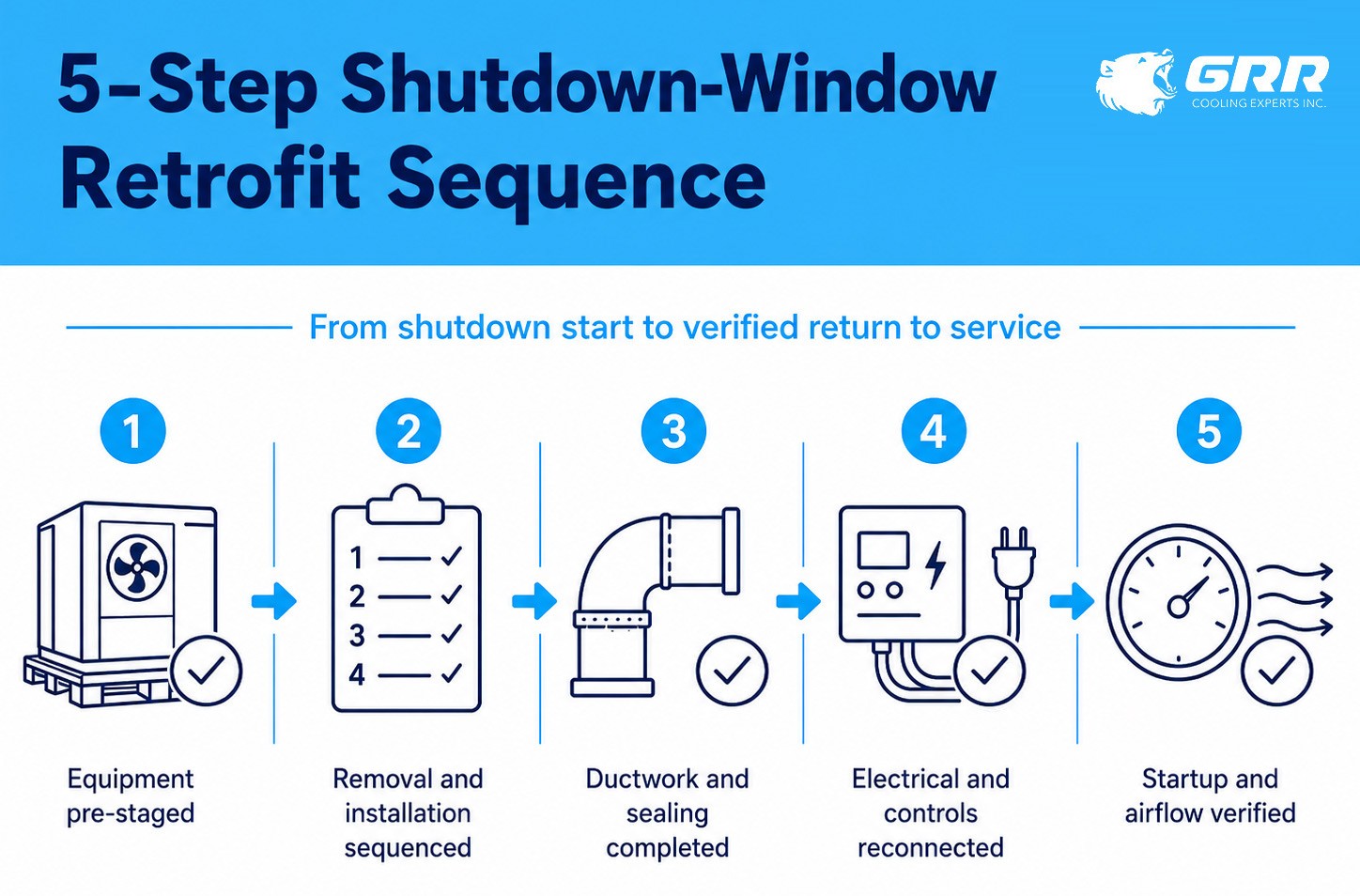
A five-step sequence for organizing HVAC retrofit work inside a limited shutdown window, from equipment pre-staging through verified airflow and return to service.
The exact sequence varies by site, but the objective remains the same: complete the work and verify system performance before return to service.
GRR project examples show why this planning matters. A fan-array upgrade for a New York City healthcare facility was completed within a 10-hour live window. In a separate hospital return-fan retrofit, GRR restored 12,000 CFM within a seven-hour work window after completing removal, duct adaptation, electrical and controls work, startup, sealing, and airflow verification.
For a closer look at how downtime and commissioning affect the equipment decision, see our guide to EC versus AC fan selection for NYC AHU retrofits.
In mission-critical environments, these systems are often reviewed early in the engineering phase as a way to reduce execution-phase operational risk during retrofit work.
GRR FIELD GUIDE
Download GRR Field Problem Notes, Volume 1
Limited-shutdown retrofit work depends on more than the number of hours available. This guide brings access, work sequencing, controls, startup, and verified airflow into one connected HVAC retrofit planning framework.
View / Download the Field Guide
Explore all GRR HVAC retrofit guides
Short Video: Explaining the Retrofit Context
The short video below provides a concept-level overview of a common HVAC retrofit reality in New York.
It explains:
why ventilation downtime is often not acceptable
how retrofit planning changes under these constraints
where EC fan arrays may fit into an engineering strategy
This video is intended to explain context and planning considerations. It does not document a specific installation or project. Detailed project examples are available through installation case materials.
See our case studies for live retrofits under limited shutdown conditions.
Where This Retrofit Strategy Is Typically Considered
In New York City, retrofit planning approaches that limit downtime are most often discussed for:
hospitals and healthcare facilities
laboratories and controlled environments
occupied commercial buildings with limited shutdown windows
Final feasibility depends on factors such as AHU layout, mechanical access, airflow requirements, control systems, and building operations.
About GRR: NYC-based retrofit engineering team serving critical environments since 2007.
Planning an HVAC Retrofit in New York
Every HVAC retrofit in NYC presents a unique set of constraints.
When downtime is not an option, retrofit planning must balance:
engineering feasibility
operational risk
installation sequencing
long-term system reliability
Understanding these constraints early in the planning phase can significantly reduce risk later in the project lifecycle.
If you are planning an HVAC retrofit in NYC with limited shutdown windows, request an engineering site assessment or send project details through our contact form.
Related Installation Examples
For real-world HVAC retrofit installations in New York, including projects completed under limited shutdown conditions, see our installation portfolio.
Featured NYC installation cases (limited shutdown windows):
12,000 CFM Hospital Return Fan Retrofit Completed Within a Seven-Hour Work Window
NYC Healthcare EC Fan Array Upgrade Completed Within a 10-Hour Live Window
This section provides practical context on how retrofit strategies are applied across different building types and constraints.
For additional visual material, including short-form installation footage and educational videos, you can also explore our video library on YouTube.
FAQ
Can HVAC retrofits in New York be completed without a full downtime?
In some cases, yes. This depends on system design, building operations, and whether the retrofit can be phased to keep airflow available.
Where are limited-shutdown HVAC retrofit strategies most commonly considered?
Hospitals, laboratories, and occupied buildings where shutdown windows are limited.
Are EC fan arrays always the right solution?
No. They are one option. Engineering feasibility depends on AHU configuration, controls, airflow targets, and access conditions.
What is the first step in planning an HVAC retrofit in NYC?
A site review to confirm operational constraints, system condition, and the feasibility of staged installation strategies.