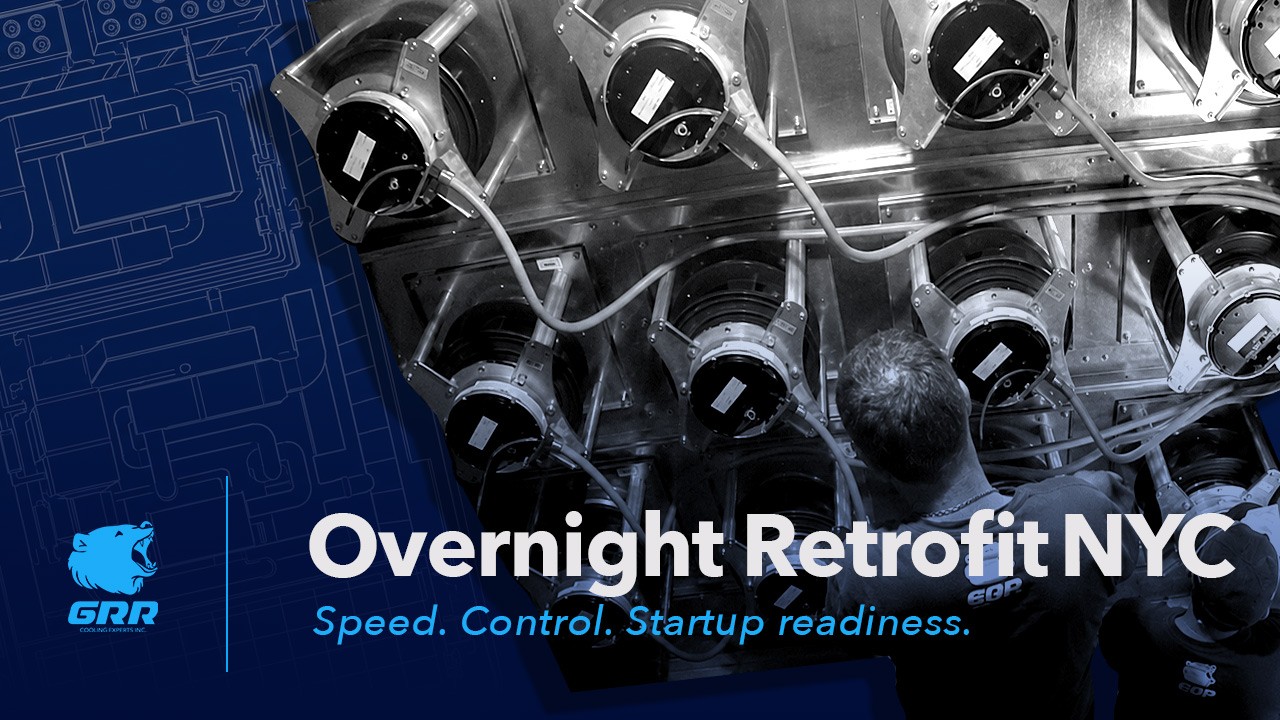
Overnight HVAC Retrofit in NYC: Speed, Control, and Startup Readiness
Overnight HVAC retrofit work is never just about working fast.
In New York buildings, the real challenge is doing the work inside a short window while keeping the sequence controlled. That matters most in hospitals, laboratories, commercial buildings, and critical facilities where HVAC disruption can affect more than comfort.
The visible work may happen at night. The real work starts earlier.
Before the crew arrives, the access path has to be checked. Equipment has to fit the actual building. Modular sections have to move in the right order. Electrical, controls, and startup work have to be coordinated before the system is expected to return to service.
That is why overnight retrofit work is not a rush job. It is planned execution under time pressure.
Overnight retrofit is not just speed
Speed matters because the work window is limited.
In many NYC retrofit projects, the building cannot simply give up a system for several days. The facility team may need the AHU, fan system, or ventilation section back before morning operations. In critical environments, that time pressure becomes even more important.
But speed by itself is not enough.
If the work sequence is not planned, a short night window can turn into a longer operational problem. The issue may not be the fan, the motor, or the equipment choice. The issue may be access, fit-up, electrical readiness, controls coordination, or startup verification.
For GRR Cooling Experts, controlled overnight HVAC retrofit work starts before the first tool comes out. The team has to understand the existing AHU, access path, equipment layout, available space, electrical requirements, controls strategy, and startup sequence before the night window begins.
The real work starts before the night window
A good overnight HVAC retrofit is not built around hope. It is built around site reality.
Before installation begins, several questions need to be answered:
• Can the equipment get into the building?
• Can the crew move through the available access path?
• Will the new fan array or retrofit section fit inside the existing AHU shell?
• Are the electrical and controls connections ready?
• Can the system be started, checked, and returned to service before building operations resume?
These details matter because older NYC buildings often have tight mechanical rooms, fixed AHU footprints, old utilities, limited access paths, and active operations around the work area.
In many retrofit projects, the challenge is not only selecting the right system. The challenge is making sure the system can be installed, connected, started, and maintained inside the building that already exists.
Before the shutdown window is scheduled, the facility team should confirm whether the AHU condition supports repair, targeted retrofit, or full replacement.
That is where retrofit planning becomes the difference between fast work and controlled execution.
Field example: live hospital return fan retrofit in 7 hours
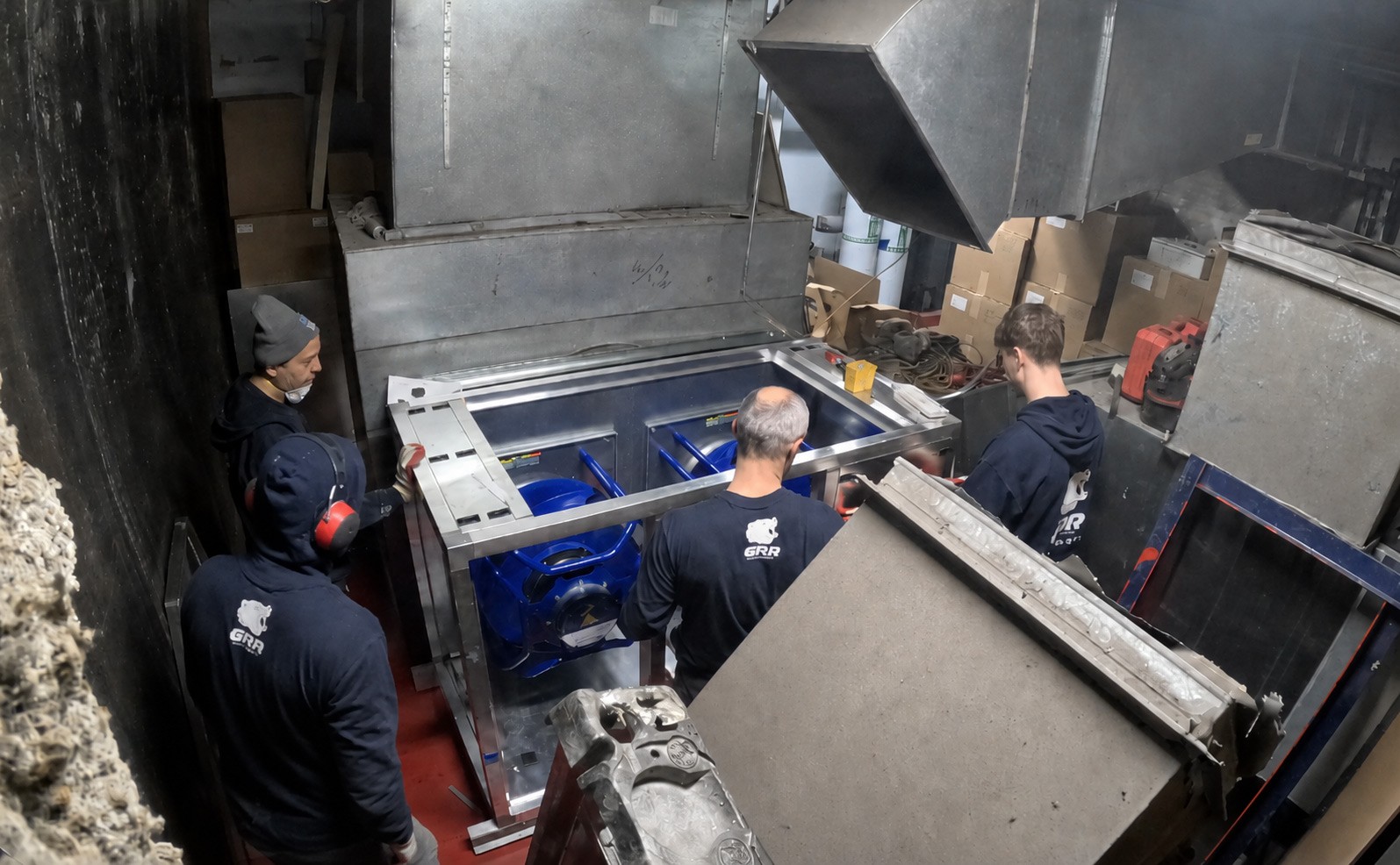
Field image: GRR completed a NYC hospital return fan retrofit in a 7-hour onsite window, including duct adaptation, electrical coordination, startup, and verification.
This related NYC hospital return fan retrofit completed live in 7 hours shows why this planning matters in real field conditions.
In a critical environment supporting an OR unit, the existing return fan assembly was removed and replaced with a new return fan package. The work included custom intake and discharge duct transitions, a new electrical panel with overload protection, speed control, reconnection, sealing, startup, and verification of stable operation.
The system was designed for 12,000 CFM of return airflow and completed in a 7-hour onsite window under active hospital operations.
The lesson is simple: short-window retrofit work depends on more than speed. Access, fit-up, duct adaptation, electrical work, controls readiness, startup, and final verification all have to line up before the system returns to service.
Related case: NYC hospital return fan retrofit completed live in 7 hours
Video proof: watch the field video on the GRR Cooling Experts YouTube channel
Video: Controlled overnight HVAC retrofit sequence
This short field video shows a controlled overnight HVAC retrofit sequence. The work depends on planning before the night window starts: access, fit-up, modular installation, electrical and controls coordination, and startup readiness before the system returns to service.
What has to be controlled during an overnight HVAC retrofit?
Overnight HVAC retrofit work usually depends on several connected steps. If one step is weak, the whole work window can become harder to control.
Access planning
Access has to be confirmed before the work starts.
In older buildings, equipment may need to move through narrow doors, corridors, service elevators, mechanical rooms, ceiling spaces, or tight areas around existing utilities. A fan array or retrofit section may be modular, but it still has to reach the AHU safely and in the right order.
If access is not checked early, the crew can lose valuable time during the actual night window.
Equipment fit-up
The new equipment has to fit the space that is actually available.
In many AHU retrofit projects, the existing shell remains in place. That means the new fan array, supports, panels, wiring, and service clearances have to be planned around the real dimensions of the existing unit.
This is one reason modular fan array design is useful in retrofit work. Smaller sections can be easier to move, position, and install inside restricted mechanical spaces.
But modular equipment still has to be planned correctly. Fit-up is not only a dimension check. It affects access, installation order, serviceability, electrical layout, controls, and future maintenance.
Modular installation sequence
The order of installation matters.
Modular sections have to move into the system in the right sequence so the crew can keep working without blocking access or creating rework. In a short night window, wasted movement becomes wasted time.
A good sequence helps the retrofit stay inside the planned shutdown or limited work window. It also helps the field team coordinate mechanical work with electrical and controls work instead of treating each step as separate.
Electrical and controls coordination
Mechanical installation is only one part of the job.
For fan array retrofits, electrical and controls coordination may include power connections, control wiring, fan speed control, overload protection, communication setup, and coordination with the building control system.
If the electrical or controls side is not ready, the system may be physically installed but not ready for operation.
That is a common retrofit risk. The equipment can be in place, but the building still does not have a system that is ready to run.
Startup readiness
The final goal is not just installation. The system has to return to service.
Before building operations resume, the team needs to confirm that the system can start, respond, and operate as expected. Depending on the project scope, that may include fan operation, controls response, airflow checks, alarm checks, and restart behavior.
In critical environments, startup readiness is part of risk control.
A retrofit is not finished because the equipment is installed. It is finished when the system can be brought back in a controlled way.
Why this matters in hospitals and critical facilities
In hospitals and critical facility environments, HVAC systems support more than comfort.
They can affect airflow reliability, pressure relationships, indoor air quality, service planning, and operational continuity. That is why overnight retrofit work cannot be treated like a simple construction schedule.
The building may need the system back by morning. The facility team may have limited room for delay. The work area may be difficult to access. The existing equipment may be old, custom, or poorly documented.
A controlled retrofit sequence helps reduce uncertainty.
It gives the facility team a clearer path from aging equipment to restored operation without using the night window as the place to figure things out.
How GRR approaches controlled overnight retrofit work
GRR Cooling Experts focuses on HVAC retrofit engineering and service for critical environments in New York.
For overnight and limited-window retrofit work, the focus is on planning the sequence before the installation starts.
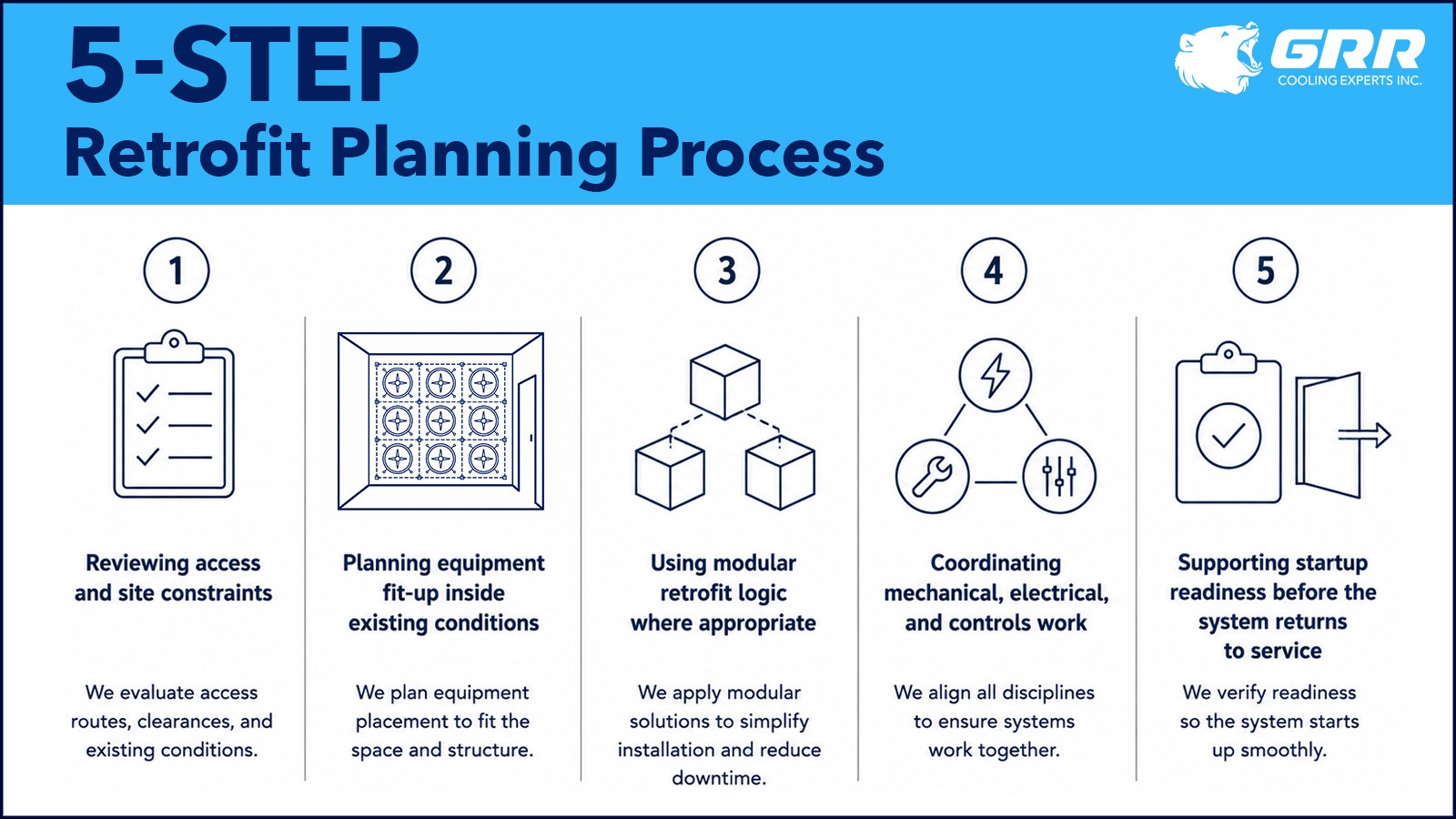
Infographics: GRR’s 5-step retrofit planning process for limited-window HVAC retrofit work in New York: access review, equipment fit-up, modular retrofit logic, mechanical/electrical/controls coordination, and startup readiness.
The process includes:
Reviewing access and site constraints
Planning equipment fit-up inside existing conditions
Using modular retrofit logic where appropriate
Coordinating mechanical, electrical, and controls work
Supporting startup readiness before the system returns to service
This approach is especially important in older NYC buildings where access, schedule, and operational requirements can shape the entire retrofit.
GRR FIELD GUIDE
Download GRR Field Problem Notes, Volume 1
Overnight retrofit execution begins before the shutdown window opens. GRR Field Problem Notes, Volume 1 shows how access review, work sequencing, controls coordination, startup, and verified return to service fit into one planning process.
View / Download the Field Guide
Explore all GRR HVAC retrofit guides
Related GRR retrofit resources
For broader retrofit planning context, see:
HVAC retrofit planning with limited shutdown windows in New York
For access-related retrofit challenges, see:
Tight-access HVAC retrofit planning in older buildings
For fan array retrofit strategy, see:
EC fan array retrofits in NYC hospitals and commercial buildings
For post-retrofit verification, see:
What needs to be verified after an HVAC retrofit?
FAQ
Q: What is an overnight HVAC retrofit?
An overnight HVAC retrofit is a retrofit project planned around a limited night work window. It is often used when building operations cannot tolerate long system disruption during normal operating hours.
Q: Why is planning so important for overnight HVAC retrofit work?
Planning is important because the work window is short. Access, equipment fit, electrical coordination, controls, and startup readiness have to be understood before the work begins. If these items are not planned, the project can lose time quickly.
Q: Why are modular fan arrays useful in retrofit projects?
Modular fan arrays can be easier to move into tight mechanical spaces and fit inside existing AHU shells. They can also support better service access and staged installation compared with one large fan assembly.
Q: What should be checked before an HVAC retrofit starts?
The main items to check are access path, existing AHU dimensions, equipment fit, electrical requirements, controls coordination, service access, shutdown window, and startup requirements.
Q: Can an HVAC retrofit be done without long building disruption?
In many cases, disruption can be reduced with proper planning, modular equipment, clear sequencing, and coordination with facility operations. The exact shutdown window depends on the system, building, and project scope.
Planning a limited-window HVAC retrofit in New York?
GRR Cooling Experts helps facility teams plan and execute HVAC retrofit work where access, schedule, airflow reliability, and startup readiness matter. Contact GRR Cooling Experts to discuss your retrofit project.