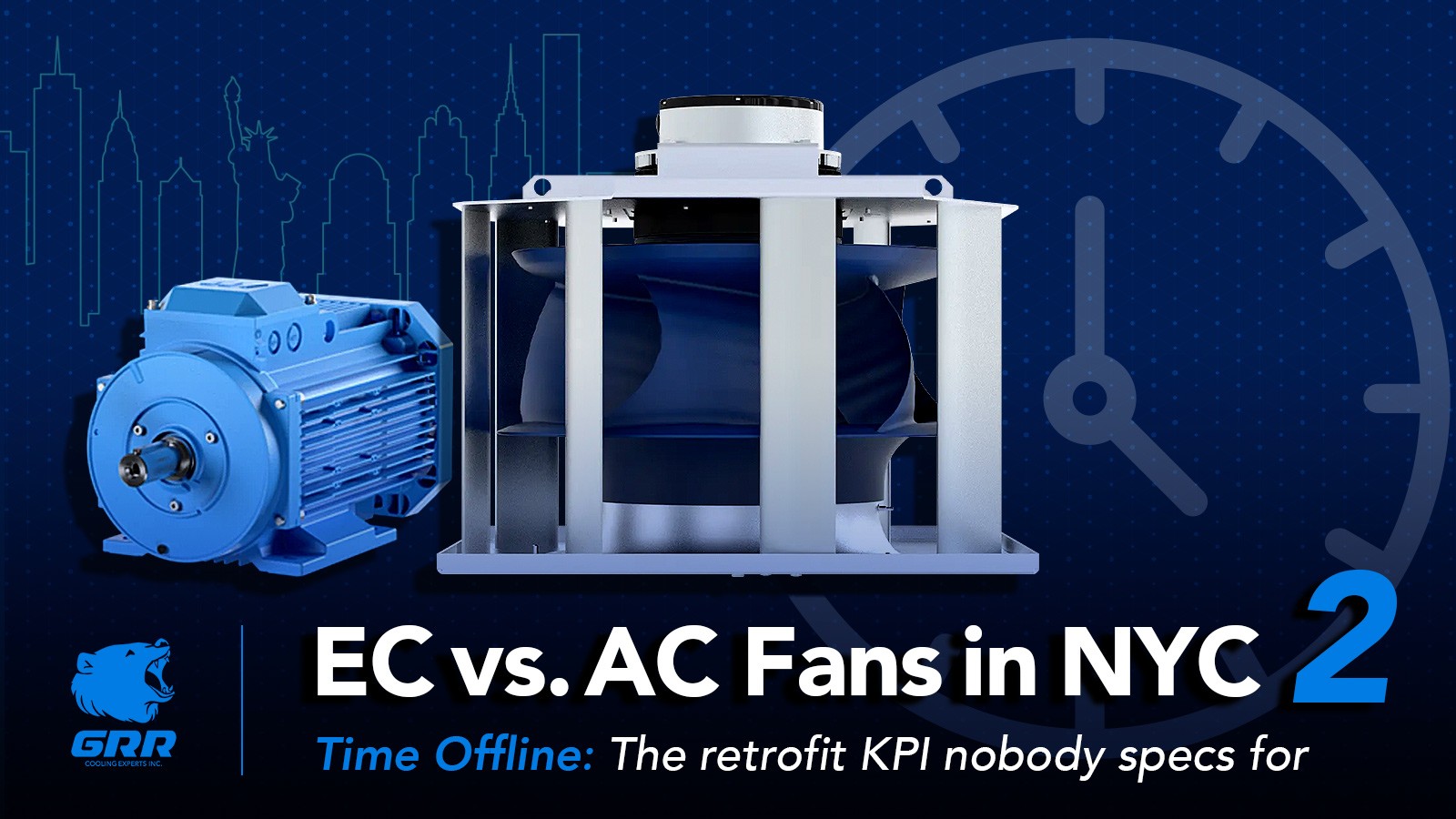
EC vs AC Fans in NYC (Part 2). Time Offline: The retrofit KPI nobody specs for
The KPI that decides the job: time offline
In New York City, the EC vs AC choice is rarely decided by airflow on a spec sheet. It is decided by time offline during an AHU retrofit in an occupied building. The real risk is downtime and instability: access constraints, replacement path, changeover sequence, controls dependency, and how predictable commissioning will be after the swap.
If you are planning a retrofit with a tight shutdown window, start with the plan, not the brochure.
Request a retrofit sequencing review
Specs vs field reality (NYC retrofit edition)
What gets compared on paper
Airflow
Efficiency
Static pressure
What decides success in NYC
Access and clearances
Replacement path and rigging constraints
Changeover sequence and recovery plan
Controls dependency
Commissioning and verification time
Specs help you choose equipment. Field reality decides whether the building can keep running while you install it.
Why time offline is the KPI that matters
Time offline is not only the minutes the fan is stopped. It includes the full instability window:
Reduced airflow or unstable airflow
Pressure swings
Control resets, alarms, and safeties tripping
Time to commission, balance, and verify stable operation
In NYC, that window expands fast when:
Mechanical rooms are landlocked and access is tighter than drawings suggest
The replacement path requires demolition, rigging, permits, or special handling
Controls scope is discovered after equipment is selected
Commissioning and balancing are treated as “later”, not part of the shutdown plan
If you want a practical definition: time offline is the time it takes to go from stable operation, through the changeover, back to stable operation that the facility can trust.
That same logic applies when Local Law 97 pushes facility teams to ask whether another repair is still the right path. The issue is not only whether the system can run again, but whether the next operating cycle becomes more reliable, controllable, and serviceable.

Retrofit planning checklist (what prevents surprises)
If you want a predictable changeover in NYC, you need a plan that goes beyond a spec comparison.
1) Access verification
Door clearances, turns, elevator limits, corridor restrictions
Removal path confirmed, not assumed
Staging location planned so work does not block operations
2) Replacement path
What gets removed first, where it goes, how it exits
What goes in, in what order, with what handling constraints
What happens if a step runs long, including a restore-airflow fallback
3) Shutdown window definition
Exact time allowed, including recovery buffer
What “stable operation” means for your space (airflow, pressure, alarms, room conditions)
Who owns the go or no-go decision at each stage
4) Controls dependency mapping
BAS points, safeties, alarms, modes, setpoints
Sensor readiness and expected control behavior after the swap
Startup behavior, fail-safes, and how the system should behave in fault conditions
5) Commissioning and verification plan
How airflow and static pressure will be stabilized
What measurements confirm success (before and after)
Who signs off, and what evidence is recorded for operations
EC technology basics (only what matters for retrofits)
EC motors (electronically commutated) use electronic control to regulate speed and torque. In retrofit work, this matters because speed control is not a comfort feature. It is how you stabilize airflow and static pressure quickly after a changeover.
When engineered correctly, EC can support:
Tighter speed control and response to load changes
Stronger part-load efficiency in systems that rarely run at peak
Cleaner tuning during commissioning
Modular retrofit approaches when used in fan arrays, when access allows
Important: the motor choice alone does not guarantee a good outcome. Access, sequencing, controls compatibility, and commissioning decide that.
Where EC helps in the field (NYC retrofit use cases)
EC can be a strong fit in NYC AHU retrofits when the goal is to reduce the instability window and make commissioning more predictable.
In practical terms, EC can help because:
speed control can help stabilize airflow faster after restart
static pressure control can be tuned and verified against real system behavior
fan arrays can allow smaller handling steps and cleaner sequencing
redundancy options can reduce “one failure equals no airflow” risk when the array is engineered around controls, commissioning, and service access
This is not automatic. The benefit comes from engineering the retrofit sequence and controls plan, not from the EC label.
For a broader explanation of why older NYC buildings are moving from large belt-driven fans to modular EC arrays, see GRR’s guide to belt-driven fans to EC fan arrays.
For a deeper look at the reliability side of this issue, see GRR’s guide to EC fan array redundancy.
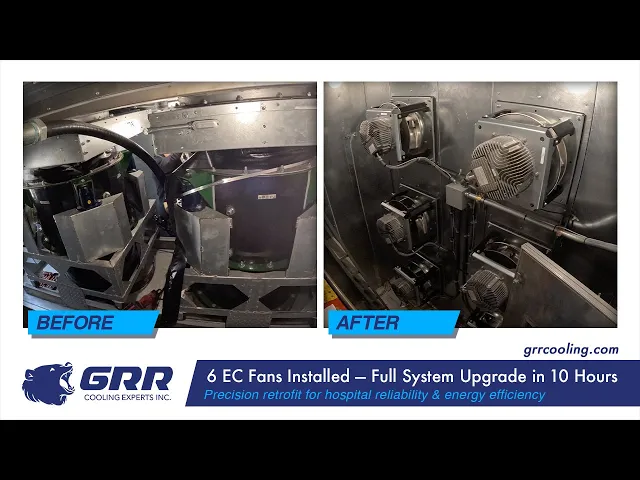
Field proof: here is what this looks like in a real NYC retrofit.
In this installation, GRR upgraded an AHU with 6 EC fans in a 10-hour window, then brought the system back to stable operation through sequencing, controls checks, and verification.
Watch the before and after video below.
More NYC Field Proof
If you want a real on-site example tied to the same KPI (time offline), here is a live hospital retrofit completed in a single shift with zero disruption. It shows the same execution reality this guide is built on: access, sequencing, controls coordination, and verification inside the allowed window. Brooklyn Hospital Coil Section Retrofit (6-hour live window).
Two viewpoints: engineer logic and facility reality
Engineer view: what we optimize for
Predictable control response across the real operating range
Static pressure stability that can be tuned and verified
Integration with safeties and operating modes without expanding downtime risk
Commissioning steps that fit overnight or weekend windows
A clean path back to stable operation, not “we will tune it later”
Facility manager view: what you get operationally
Lower downtime risk and more predictable changeover windows
Fewer surprises because access and recovery steps are planned early
Faster troubleshooting when alarms and operating states are clear
Better stability after restart and fewer occupant complaints
Cleaner handoff documentation for building engineers and vendors
This is why the retrofit KPI is time offline. It maps directly to operational risk.
Monitoring and verification (visibility, not buzzwords)
After a retrofit, the most expensive problems are the ones you cannot see. A good plan includes a baseline so operations can detect drift and diagnose issues faster.
A practical approach includes:
A commissioning baseline documented after startup
Trending key signals where available (static pressure, fan speed, alarms, modes)
Clear notes on setpoints, safeties, and what “normal” looks like
A simple service playbook: what to check first when something looks off
Result: fewer blind service calls, faster diagnosis, and more predictable performance.
When EC is not the right fit (engineering honesty)
EC is not always the best answer. Some edge cases still pencil better with AC plus VFD and upgraded controls:
Very large single-fan duties with atypical pressure envelopes
Strict procurement constraints or owner standards that limit options
Projects where controls scope or incentives make an alternate path more practical
The best choice is the one that produces the safest and most predictable changeover within your building constraints.
Proof, not theory
If you want real NYC field examples:
About GRR Cooling Experts
GRR Cooling Experts Inc. is a New York–based HVAC retrofit engineering company specializing in ventilation upgrades for hospitals, laboratories, schools, and commercial buildings.
Since 2007, our team has delivered more than 400 retrofit and service projects across the NYC metro area, improving airflow reliability, energy efficiency, and Local Law 97 compliance through precision EC fan array retrofits and critical-environment ventilation solutions.

————————————————-
Frequently Asked Questions (FAQ):
Q: What is the real difference between EC and AC in retrofit projects?
A: In retrofit reality, the difference is often control behavior and how predictable the changeover and commissioning are. Specs matter, but downtime risk usually decides the best path in NYC.
Q:What typically drives downtime during a fan retrofit in NYC?
A:Access constraints, replacement path surprises, sequencing gaps, controls dependency, and the time required to commission and verify stable operation.
Q:Do EC retrofits always require controls changes?
A:Not always, but there is always a controls dependency to evaluate. The safe approach is to map the control strategy and verification steps before the shutdown window.
Q:When does an EC fan array make sense for an existing AHU?
A:When access is tight, uptime is critical, and you need a retrofit path that can be sequenced in smaller steps with a predictable return to stable airflow.
Q:How do you estimate changeover time before the shutdown window?
A:Verify access and removal path, define the sequence step by step, confirm controls scope, and align commissioning and balancing with the window. If any of those pieces are unknown, the window estimate is a guess.
Q:What information do you need to review an AHU retrofit plan?
A:AHU basics, access constraints, uptime limits, existing control architecture, and what stable operation means for the space (airflow, pressure, alarms, and operational requirements).
Q:What is the safest approach in occupied buildings?
A:Engineer the sequence around risk, define recovery steps, and plan commissioning and verification inside the allowed window. Treat verification as part of the changeover, not an optional add-on.
Next step
If you have an AHU retrofit coming up in NYC, we can review access constraints, sequencing options, and controls dependencies before you commit to a replacement path.