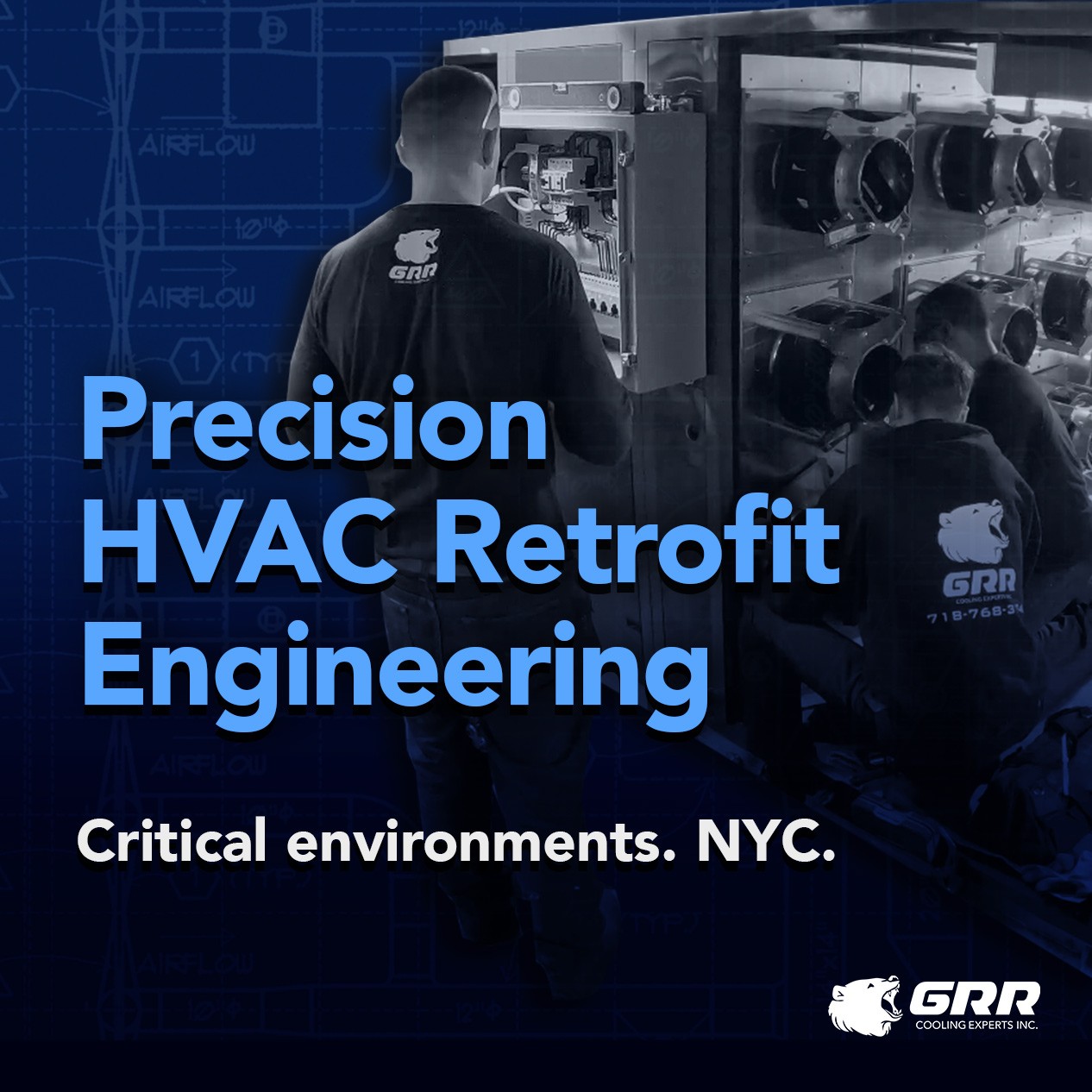
National Engineers Week: HVAC Retrofit Engineering in NYC + Tri-State
National Engineers Week ends, but the work does not
National Engineers Week is a good reminder of what building teams deal with year-round: engineered systems only matter when they perform under real constraints.
At GRR Cooling Experts, we deliver precision HVAC retrofit engineering for critical environments where airflow stability, controls behavior, and serviceability are not optional. Our work supports hospitals, labs, and large commercial buildings across NYC and the Tri-State area (NY, NJ, CT).
If you are in planning mode and want to see how we approach retrofits in occupied buildings, start here: Services
What precision retrofit engineering means in the field
Retrofits are often framed as equipment replacement. In critical environments, outcomes are decided by details that do not show up in a brochure.
1) Downtime planning and shutdown windows
Critical sites run on tight schedules. A plan must match field reality: access, staging, safety, temporary measures, and step-by-step startup verification.
If you want field proof, use the case library: Case Studies hub
For a real hospital example completed inside a live-facility window, see: Fan Array Upgrade for NYC Healthcare
2) Serviceability and access
A retrofit that cannot be maintained becomes a future failure. Service clearances, filter access, safe electrical access, and a workable maintenance path are part of engineering, not an afterthought.
Practical retrofit guides and checklists live here: Downloads page
3) Controls stability and restart behavior
Many retrofit problems show up after restart, not during installation. Stable sequences, sensor placement, and part-load behavior are what keep performance consistent.
A field-driven engineering note on retrofit decision-making is here: EC vs AC retrofit reality article
4) Airflow verification, not assumptions
In critical environments, airflow is not guessed. Engineering requires measurement and verification. This is where commissioning and balancing thinking protects the result.
If you want more background and field context on why this matters in NYC buildings, see: Why NYC buildings switch to EC arrays
Critical environments in NYC and the Tri-State
Across NYC and the Tri-State, critical facilities often share the same retrofit constraints:
Limited space in mechanical rooms
Access restrictions and coordination across teams
Narrow shutdown windows
High consequences for unstable airflow or controls issues
That is why retrofit engineering has to be practical. The best plan is the one that survives the site conditions.
Common triggers for AHU and HVAC retrofits
Most retrofit conversations start with one of these:
AHU reliability issues or repeated failures
Airflow instability, pressure problems, or recurring comfort complaints tied to control behavior
End-of-life fan systems that are hard to service or cannot meet operational requirements
Renovation timelines that require upgrades inside tight windows
A need to modernize systems while keeping operations running
If you are facing one of these, a retrofit assessment should look beyond replacement and focus on risk, access, controls, and verification.
The GRR approach: problem, action, result
Problem: A system is underperforming or reaching end-of-life in a building that cannot tolerate downtime.
Action: Retrofit engineering that accounts for access, shutdown windows, controls integration, and verification.
Result: A maintainable system with stable performance after restart and measurable outcomes in the field.
Service area
GRR Cooling Experts serves NYC and the Tri-State area (NY, NJ, CT), including Bronx, Manhattan, Brooklyn, Queens, Staten Island, Long Island, and surrounding metro markets.
Next step
If you are planning an AHU retrofit or need engineering support for a critical environment, Contact